


2020 Year in Review
Defense & Government | Security | Critical Infrastructure | Maritime
Download Full Report
Year in Review
TMG Clients Completed IPOs or M&A Transactions in 2020
- These TMG clients completed IPOs or M&A transactions in 2020: 1901 Group, Cypress Creek Renewables, METIS Solutions, OPAQ Networks, SOC Telemed, Collaborative Solutions, Innovative Decisions, Inc. (IDI), NeuroRx, Shattuck Labs and TeraThink.
2020 US M&A Activity
- Coming off a strong 2019, the M&A market slowed in 2020 due to the COVID-19 pandemic. Despite substantial declines in Q2 transactional volume, the market fought back to only end the year down 24%, compared to the prior year. Notably, the Security industry proved resilient to the pandemic’s widespread impact and out-performed the S&P 500 by 16%.
- In early 2020, M&A activity continued at the robust levels that we have been observing for the last several years, but as the pandemic developed, U.S. M&A activity declined significantly. Activity remained depressed for roughly a quarter as many deals were put on hold or canceled due to financial constraints, market uncertainty, and the increased difficulty of closing deals virtually. In particular, the M&A market experienced a drought of mega deals, with a disproportionate number of smaller deals occurring around the onset of the pandemic.
- Around the beginning of the third quarter, M&A activity picked back up and volume is now above pre-pandemics levels. Pent-up deal appetite after the onset of the pandemic as well as a rush to complete transactions before possible tax hikes in 2021 may have bolstered M&A activity.
Resiliency of Defense and Government Services Market
- The federal government budget is historically less volatile than consumer spending, which has helped federal contractors largely insulate themselves from broader market downturns. This held true in 2020 as federal contractors fared relatively well compared to other industries, despite limitations working on government sites and a difficult recruiting/onboarding environment
Relatively Seamless Transition to Remote Work
- The pandemic forced most workers in our covered market segments to “WFH” and generally this transition was more seamless than many anticipated
- While defense and government M&A activity and valuations were largely unaffected by the pandemic, segments of the security and critical infrastructure markets saw major first and second order disruptions, such as a decline in physical security and an increase in cyber security
- The remote work environment provided further justification for federal IT and cyber spending initiatives
Attractive Market Valuations, Low Interest Rates, and Availability of Capital
- Consolidation of service offerings through M&A continued in 2020, despite a slowed M&A market largely in the 2nd quarter
- A unique buying environment with low interest rates, availability of debt capital, and increased “dry powder” from private equity sparked significant M&A activity in all market sectors we cover, with an emphasis on Security and Government Services
Elevated Private Equity Activity with New Market Entrants
- New private equity funds with a focus on the DGS, Security, and CI markets have emerged over the past few years; the relative resilience of valuation in these sectors during the pandemic has further encouraged new entrants into these markets bringing “dry powder” and looking for deals to an all-time high
- While many strategic buyers stayed on the sidelines during Q2 and Q3, private equity (especially at the portfolio company level) filled this gap in M&A activity; across our segments PE activity accounts for approximately 40% of deal activity, compared to 34% in 2019
Positioning Around Capital Gains and Estate Tax Policy
- In anticipation of significant capital gains and ordinary income tax increases over the next few years from the new administration, many businesses turned to M&A markets for liquidity. We saw similar activity in Q3 and Q4 of 2012 as the promise of tax increases likely pulled future M&A activity into the current year
- Potential sunsetting of estate tax exemptions continues to drive significant business valuation and asset appraisal activity within our firm (and the market as a whole) as owners employ gifting strategies
SPAC and IPO Activity; Headwinds in a Dynamic ESOP Environment
- Equity capital market activity was extremely active, with IPO and specifically SPAC volume near all-time highs - evidenced by the 242 SPACs that were introduced in 2020, four times the amount raised in the previous year
- ESOP activity declined even for healthy companies; regulatory pressure as well as COVID-19 concerns have put pressure on trustees and made these transactions more difficult to complete
Pandemic Recovery - Impact of Vaccine and Pace of Roll-Out
- There remains uncertainty around the timing for a broad rollout of the COVID-19 vaccine
- It appears that the status quo could extend longer than we would have liked or anticipated
- It is clear is that the COVID-19 pandemic has permanently changed the way people work and consume – leading to structural changes in our covered industries
Workforce Changes – Does This Open New Government Centers of Gravity?
- Within the federal market specifically, the pandemic has resulted in technology upgrades and changes in agency operations to accommodate remote work
- With the exception of certain areas of the intelligence community (IC) where on-site is required for security reasons, remote work at scale now appears to be a permanent fixture within agency operations
- This trend could open new opportunities and “centers of gravity” in the competition for talent. With recruiting no longer confined to the DMV and other government/DOD centers, tier-two markets with lower cost of living and highly-skilled employees could flourish in the Defense and Government sector
Continued Focus on IT Modernization, Cybersecurity, and Supply Chain Security
- Remote work necessitated IT modernization and justified the continuation of these initiatives
- The pandemic clearly highlighted cybersecurity, and supply chain vulnerabilities, with cyber attacks estimated to have increased by 400% during this period
- The cybersecurity industry is continuing to try to understand the damage from the SolarWinds hack, which was absolutely devastating and has permanently changed the market and broader industry’s view of best practices
Availability of Capital – How it’s Deployed Now Could Impact the Next Decade
- Private equity and debt capital allocated to our core markets is at an all-time high, and industry professionals are “on the clock” to deploy this capital in smart ways that will yield superior returns for investors
- How this money is invested in 2021 could define “winner and losers” within our covered sectors and shape the direction of these industries over the next decade. Do we see continued digital convergence in the security market? What critical infrastructure initiatives and upgrades receive industry funding? Does the availability of capital paired with budget headwinds lead to further consolidation in the defense / government markets?
Political Considerations – New Administration, Long-Term Budgets, Tax Policy
- While it is not currently clear that there will be a major shift in government spending priorities with the new administration, once the vaccine has been rolled out and the COVID-19 pandemic is stabilized, we might anticipate a renewed focus on budget priorities that could put pressure on defense spending overall
- What is clear is that there will be a push to increase taxes, which will potentially impact M&A activity as well as valuations in the equity capital markets
- Additionally, the combination of reduced tax revenues during the pandemic as well as the trillions of dollars spent on pandemic stimulus packages will put pressure on budgets as a whole going forward
Defense & Government
Prior to COVID-19, M&A activity in the Defense and Government Services (DGS) industry was occurring at record levels, having experienced three years of continuous growth in volume and increases in valuations
DGS M&A activity experienced a sharp decline as a result of the pandemic, with Q2 activity down 22% year-over-year. However, this decline was less severe than the 34% decline that the general M&A market experienced over the same period
DGS M&A activity has since resumed at pre-pandemic levels as Q3 and Q4 deal count and transaction value returned to normal, signaling an optimistic outlook for 2021
Throughout the year, the primary sources of market uncertainty were the COVID-19 pandemic, and the potential impact of a new administration’s polices. These concerns have largely subsided with the delivery of a vaccine and the view that changes to spending priorities and tax policy are projected to be moderate
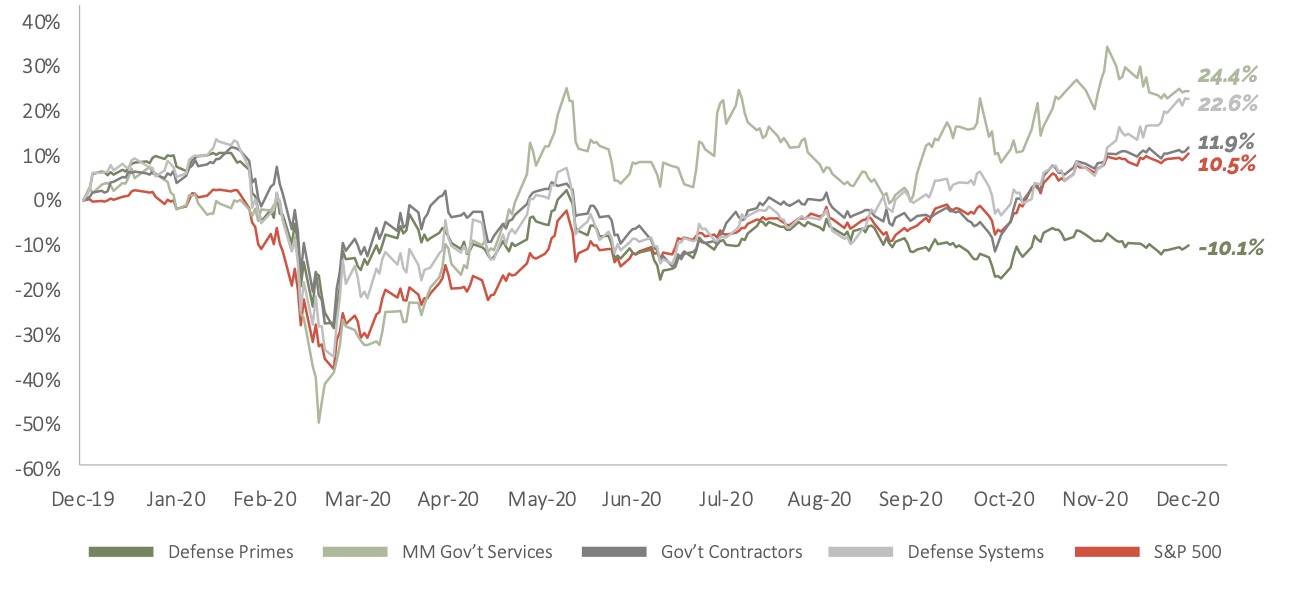
All TMG custom Defense and Government Services indices have experienced significant volatility in 2020. Most have since recovered, primarily driven by the insulation that the federal sector provides as government spending has remained strong despite an economic downturn. Government software companies have performed particularly well as they are further insulated by their subscription business models in addition to benefitting from robust government technology spending.
Defense Primes: In general, Defense Primes continue to lag behind the recovery of the general market. This is due in large part to their exposure to aerospace, which was hampered by the decrease in travel and oil demand. However, the Defense Primes’ other business segments outside of aerospace have performed relatively well. Defense Primes will likely continue to be held back by aerospace going into 2021 as other business units continue to excel.
Middle Market Gov’t Services: Although TMG’s Middle Market Government Services sector is up 24.4% in 2020, it has largely been carried by a few stocks that have had a stellar year. Going forward, this segment is expected to benefit from a stable budgetary environment as both political parties will likely be more focused on larger issues, rather than budget cuts, such as pushing for a return to normalcy after a turbulent 2020.
Gov’t Contractors: Government Contractors generally performed well in 2020, evidencing the insulated nature of the sector. Companies, particularly tech-enabled ones, greatly benefited from strong government spending on emerging technologies and IT modernization. The robust government spending in these areas is expected to continue and as a result, many companies will try to position themselves accordingly.
Defense Systems: Throughout the pandemic, defense spending has remained strong and the 2021 budget proposal calls to increase the defense budget to $740.5B. DoD continues to progressively change its procurement approach, including utilizing other transaction authorities, contract vehicles, SBIRS, and other rapid solicitation and technology access vehicles which provide Defense Systems with multiple avenues for securing contracts.
Custom Index Performance
 Open page 10 of the report →
Transactions by Quarter
Select 2020 Transactions
Security
Although the Physical Security & Security Solutions markets experienced a sharp decline in Q2 2020 transaction volume, they have since resumed at pre-pandemic levels with Q4 deal volume finishing tied for the highest of any quarter in the last three years with 49 deals
Private equity bolt-on acquisitions to platform investments continue to be a popular strategy especially in the Security Services sector where GardaWorld (owned by BC Partners) and Allied Universal (backed by a consortium of private equity firms) have both been extremely acquisitive
M&A activity has been robust due in part to an exponential increase in the potential surface area of a cyber-security attack as a result of the high demand for remote work provisions
This trend is expected to continue through 2021 while incident response will likely increase as cyber intrusions become enumerated over the course of the year
Recent attacks, such as the SolarWinds data breach in December 2020, have underscored the importance of strong cyber-security and have permanently changed the industry’s view of best practices
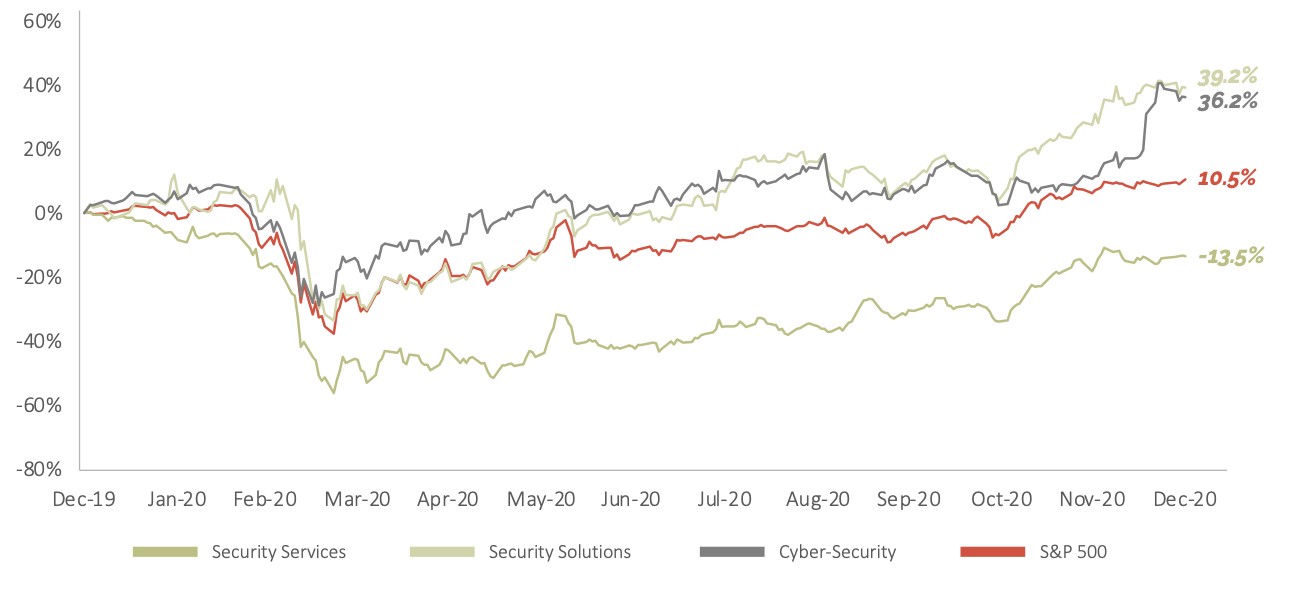
Similar to most other industries, the Security industry has largely recovered from the pandemic as companies adjusted to the altered operating environment. Generally, security solutions and technologies which can be delivered virtually or with limited human contact have performed well, while in-person security services have been adversely impacted due to social distancing and limited in-person contact. Despite these differences, the Security industry broadly has had a strong performance in 2020 as people and businesses continue to require protection for themselves, their assets, and their data.
Security Services: Security services companies have struggled in 2020 as many of these companies provided guarding services to industries that were hit hard by the pandemic such as aviation. A sizeable amount of companies were also negatively impacted by a decrease in cash processing at the onset of the pandemic and may be impacted going forward as the accelerated global shift towards e-commerce continues.
Security Solutions: TMG’s custom Security Solution sector increased 39.2% in 2020. Demand for security systems continues to be driven by a variety of factors including de-urbanization, household formation growth, increasing smart home adoption, and escalating consumer demand for security. Additionally, many security solutions companies operate using subscription models which help protect them from decreases in consumer spending.
Cyber-Security: Cyber-security companies have been on an amazing tear in 2020, particularly towards the end of the year. Cyber-security has become even more important in 2020 as many people are forced to work from home. Additionally, there has been a record number of cyber attacks recently, which has further increased the need and demand for strong cybersecurity.
Custom Index Performance
 Open page 17 of the report →
Transactions by Quarter
Select 2020 Transactions
Critical Infrastructure
Entering 2020, the Critical Infrastructure industry was at a five-year high in terms of deal count / value
The industry’s decline in 2020 transaction activity was offset partially by the strong performance of the Systems and Solutions sector in Q4 2020, which is expected to continue in 2021
Despite the decline, the Municipal Utility Space subsector experienced strong transaction volume as large players such as American Water Works, California Water Service Group, Essential Utilities, and Global Water Resources continued to drive consolidation and activity
Looking forward to 2021, expect a continued shift to decentralized wastewater treatment using distributed systems, which can better address localized contamination sources, provide water reuse for irrigation and drinking water, and recover biosolids
Strong interest in smart digital water technology is expected as well, including sensors, satellites, drones, and machine learning, all of which improve asset management and system optimization
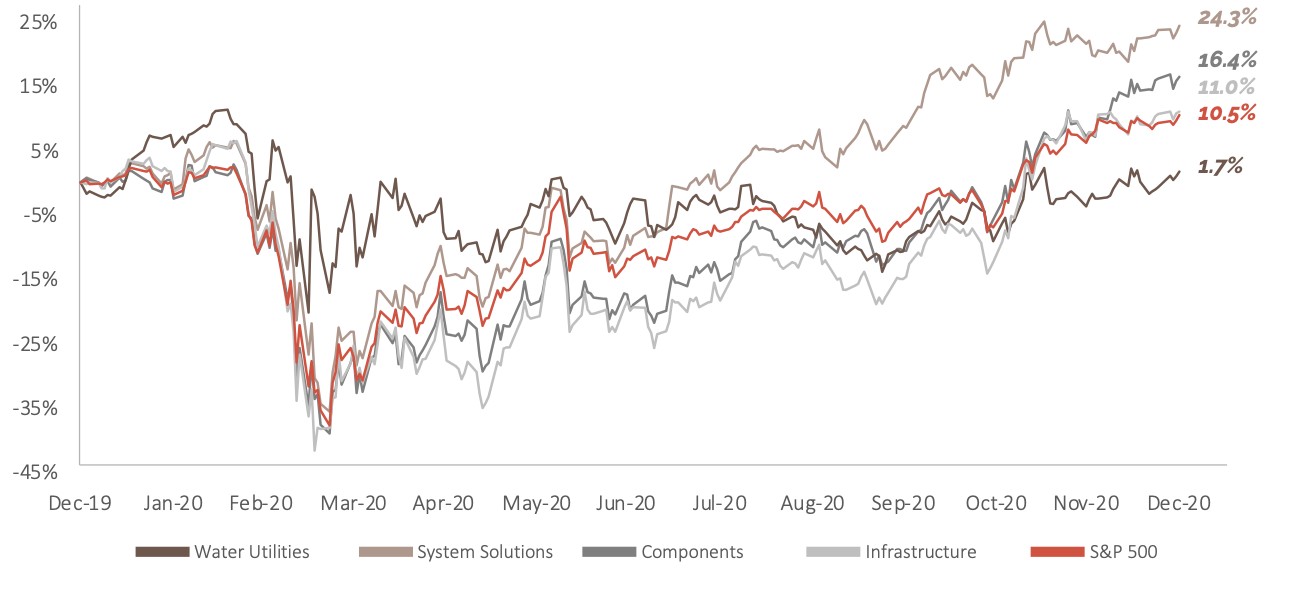
The Critical Infrastructure and Water industries were quite resilient this year, with most sectors closely tracking to the S&P 500. The industry’s 2020 performance has varied across the four TMG custom sectors with the System Solutions and Water Utility sectors having outperformed the S&P 500 throughout the pandemic, as investors moved to more insulated investments. Additionally, certain sectors such as System Solutions benefited from their exposure to the healthcare markets. By the close of the year, most of the Critical Infrastructure industry had recovered with only the Water Utilities sector lagging behind the S&P 500.
Water Utilities: The Water Utilities sector has remained relatively stable throughout 2020. Utility companies saw a slight decrease from commercial customers as companies moved their workforces remote. This was partially offset by an uptick in residential water use. State orders to suspend collection as well as service suspension efforts have minimally impacted the sector.
System Solutions: By supporting critical industries such as healthcare and water utilities, the System Solutions sector faired well in 2020 as companies supplying fluid systems in the development of healthcare products experienced significant demand. This activity helped offset project delays seen in other end markets. Many companies also saw an increase in residential sales as customers invested in home improvement projects and pools.
Components: Continued demand for smart digital water products and technologies helped to fuel growth in this sector in 2020. However, many component companies, which had exposure to the oil and gas industries, experienced revenue declines and project delays as demand for these resources decreased.
Infrastructure: Funding uncertainties as well as disruptions due to the pandemic led to project delays in the sector, creating a challenging 2020. Looking forward to 2021, the sector is well positioned for growth as U.S. infrastructure spending is expected to increase over the coming years.
Custom Index Performance
 Open page 26 of the report →
Transactions by Quarter
Select 2020 Transactions
Maritime
Pandemic-related travel restrictions greatly hampered demand for oil, leading to significant decreases in crude oil prices and an excess capacity in the industry
2020 Maritime M&A was negatively impacted by the decrease in oil demand as deal volume fell ~31% YoY
Those participating in M&A concentrated their efforts on organic growth as well as vessel sale and purchase (S&P) rather than typical corporate acquisitions
Looking ahead to 2021, CO2 and sulfur regulations are anticipated to be a major driver of M&A activity as regulatory navigation, corporate governance, and transparency will drive bank lending
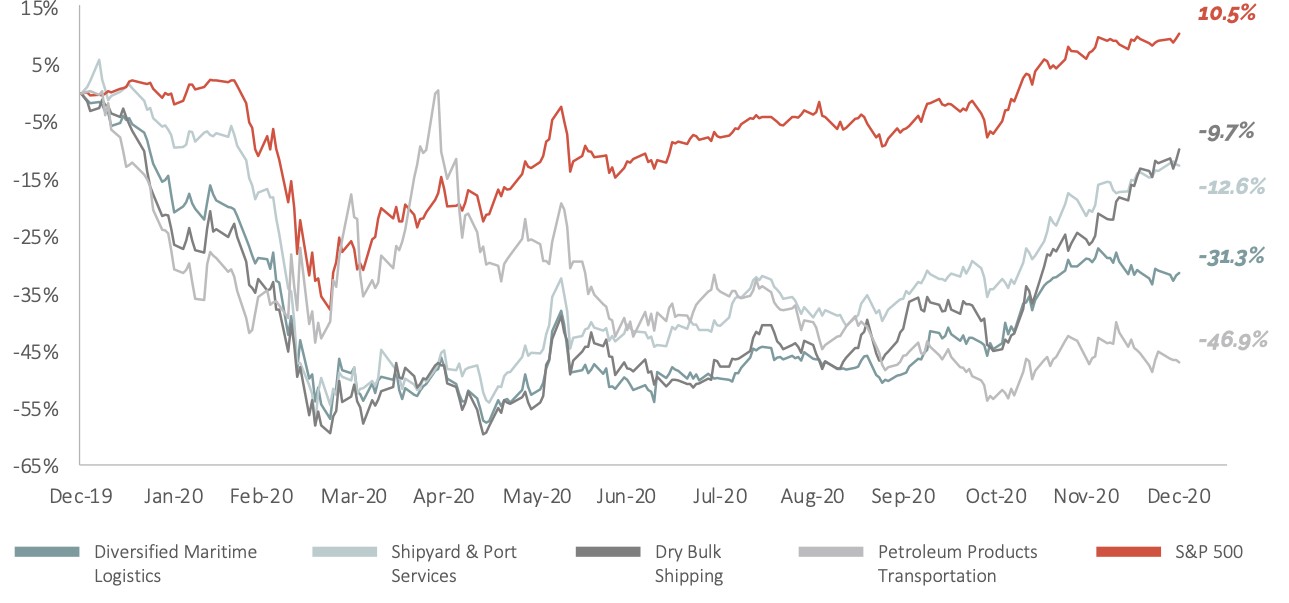
As a result of the decline in oil demand, all the sectors of the Maritime industry underperformed the S&P 500 for most of 2020. This is largely due to the industry’s involvement in the transportation of oil and gas and other bulk commodities, the trade of which suffered the sharpest decline in over 30 years.
Diversified Maritime Logistics: Performance among Diversified Maritime Logistics companies has varied greatly. The pandemic has shifted consumer spending from travel towards e-commerce, which relies on transit between Asia and the U.S. This trend however, negatively impacted freight routes to tourist locations. Outlook for 2021 is positive with elevated e-commerce activity expected to continue and travel (both business and leisure) to gradually recover.
Shipyard & Port Services: Shipyards and Port Services faced a challenging year due to volatility in the oil and gas markets, which resulted in many project delays. The sector has seen a positive trend related to infrastructure spending as firms and governments continue to increase their spending in preparation for hurricanes and tropical storms. The 2021 outlook is positive as the market recovers and projects resume.
Dry Bulk Shipping: Dry Bulk Shipping companies faced significant head winds in 2020. The pandemic affected supply chains of all cargos with Clarksons estimating total dry bulk tons to have contracted 2.7% and ton-miles by 2.3% in 2020. Activity from China has been positive with steel production and demand for grains and soybeans at record high levels. Outlook for 2021 is positive with Clarksons estimating dry bulk trade to rebound.
Petroleum Products Transportation: Global decline in oil demand created a difficult year for the sector. The IEA estimates 2020 global oil demand to be 91.2 million barrels per day (mb/d), 8.8 mb/d lower than 2019, primarily due to weak demand for jet fuel/kerosene. 2021 outlook is positive with demand expected to increase to 96.9 mb/d and seaborne petroleum exports and ton-miles estimated to increase 6.1% and 6.4% respectively.
Custom Index Performance
 Open page 37 of the report →
Transactions by Quarter
Select 2020 Transactions
Read the 2020 Year in Review
Speak With the Team
Download the Full 2020 Year in Review
Complete deal tables, valuation multiples, public company comps, and contract awards across all four sectors.
The information provided in this newsletter is for informational purposes only and does not constitute an offer to sell or the solicitation of an offer to buy any of the securities mentioned herein. Past performance does not guarantee future results. None of the information or analyses presented are intended to form the basis for any investment decision, and no specific recommendations are intended. Any performance mentioned does not include transaction fees and costs, which would reduce an investor's return. An investment cannot be made directly in these custom market indices. Public market valuation multiples are provided for reference purposes only and reflect traded equity values, which may differ materially from private company transaction pricing.
The logos and company names used in this report are for illustration purposes only, and the report is not associated with or supported by the owners of the trademarks.
© 2026 The McLean Group. All rights reserved. Securities transactions are conducted through McLean Securities, LLC, a member of FINRA/SIPC.