
2021 Year in Review
Defense, Government & Intelligence | Security | Critical Infrastructure | Maritime
Download Full Report
Year in Review
Key Takeaways
- The overall M&A market in 2021 saw record high volumes and strong valuations, with private and public valuations near all-time highs. Specifically, the defense and government services market has proven to be extremely resilient during the pandemic
- COVID-related delays in contract awards have largely subsided therefore reducing the need for shorter-term bridge funding, which historically was leading to reduced backlogs and increased re-compete risk for many in the sector
- Significant exits to large strategic buyers evidenced the robust valuation environment and opportunity to realize significant investment returns on platform investments
- The pandemic further validated initiatives around IT modernization, cloud services and migration, cybersecurity, and supply-chain security, among others
- Pressures remained on private equity to continue to deploy capital; government market seen as a “safe haven” as evidenced by insulation from economic downturn as a result of initiatives like the CARES Act – little to no loss in billable hours
- Active financing markets and inexpensive debt further drove deal activity
- Impact of long-term federal and state & local budget realities significantly impacted the market
- Continued SPAC activity through valuation and regulatory headwinds
- Dynamic ESOP environment with increased DOL pressure on trustees, potential tax increases, and federal contracting support for ESOPs
- Potential increases in capital gains tax rates and uncertainty around tax implications in general partially drove short-term deal activity
- Projected decrease in estate tax exemption drove some restructuring activity at the personal level
2021 Was the Most Active Year in a Decade
- U.S. M&A activity in 2021 was the most active year from a deal count perspective in the last decade. This was largely driven by a combination of 2020 deals that were pushed to the right due to COVID-19; an increased sense of urgency to sell ahead of potential capital gains tax rate increases in 2022; and low interest rates, which resulted in an advantageous cost of capital from a financing perspective. Looking ahead to 2022, we are expecting to see the M&A market remain active, but the underlying factors, which resulted in a record-breaking 2021 may not be quite as strong or prevalent.
- As noted above, the rampant 2021 M&A activity was largely driven by a combination of factors. As a result, there wasn’t a monthly or quarterly trend / spike in terms of deal activity, but rather a consistent level of activity across the entire year. The increase in Nov-21 and Dec-21 was largely driven by year-end closing considerations as well as the push to close transactions ahead of a potential capital gains tax increase on January 1, 2022. Concerns around the tax issue have since subsided but there were several outcomes at play throughout the year, which fueled activity.
- U.S. deal count by year (S&P CapIQ): 23,996 in 2021, up from 18,296 in 2020.
Water Consulting Specialists (WCSI) acquired by Evoqua Water Technologies
- Evoqua Water Technologies (NYSE: AQUA) acquired Water Consulting Specialists Inc. (WCSI), a leader in the design, manufacturing, and service of industrial high-purity water treatment systems.
- The acquisition will enable Evoqua to expand in key industrial markets including pharmaceuticals and healthcare as well as provide access to additional customers in the northeastern region of the U.S.
- WCSI’s high-purity water filters complement Evoqua’s product offering and allow the company to expand its digitally enabled water solutions.
Triad Interactive acquired by McGraw Hill
- McGraw Hill, a leading provider of customized education content, acquired Triad Interactive, a developer of e-learning software for higher education establishments.
- The two companies have been longtime business partners on Triad’s flagship program SIMnet.
- The combined entity will now work together to improve SIMnet through increased implementation and customer support, while also exploring new markets in order to bring the product to a wider audience.
Protas Solutions acquired by Criterion Systems
- Criterion Systems acquired Protas Solutions, a provider of data science, software engineering, and management consulting services to the Intelligence Community (IC).
- Protas will operate as a wholly-owned subsidiary of Criterion, specifically within its Intelligence Solution business unit, which focuses on providing systems integration, software engineering, and cyber operations-focused services.
- Protas will join Realm Consulting to enable Criterion to deliver a broad range of innovative IT solutions to the IC.
- Both of Protas’ owners will continue with the business via executive roles at Criterion.
ARRAY acquired by CGI
- CGI acquired ARRAY in an effort to expand its federal division’s footprint into the U.S. Air Force and Space Command markets.
- ARRAY is a leading application and digital services provider for the U.S. DoD and other government organizations.
- The merger will bring 275 ARRAY professionals to CGI and enhance the company’s position as a leading provider of digital modernization services to meet public sector client needs.
- As a result of the acquisition, CGI Federal has decided to reorganize its operations by dividing its four previous sectors into seven separate business practices.
Fire Team Solutions: equity and debt investment by AE Industrial Partners
- AE Industrial Partners made a significant equity and debt investment in Fire Team Solutions, a leading provider of mission-critical technology services to the Intelligence Community (IC).
- Its core services include secure cloud architecture and analytics; software development and automation; and systems engineering development and integration.
- Fire Team will leverage AE’s operational support and industry relationships in order to continue its growth and development of state-of-the-art technology solutions.
- The investment from AE Industrial was made through its Structured Solutions I fund.
Cerilian acquired by The KACE Company
- The KACE Company, an affiliate of MVM Security, acquired Cerilian, a leading provider of cloud engineering and big data solutions, cybersecurity, and software development services for the Intelligence Community (IC).
- The acquisition will further expand KACE’s presence in the national security market by augmenting its legacy data, analytics, and mission IT solutions capabilities with new cloud architecture and design, DevOps, security, and machine learning capabilities.
- Cerilian’s CEO, Josh Curry, will join KACE as the Director of Systems and Engineering.
Nusura acquired by Juvare
- Juvare, a global leader in critical incident preparedness and response technology, acquired homeland security and emergency management consulting technology company, Nusura.
- The acquisition will allow Juvare to offer an industry-leading preparedness training solution, SimulationDeck, and expand its presence across the defense and emergency management landscape.
- The combined entity will provide an unparalleled platform to streamline operations during crisis situations.
Undisclosed AI-enabled linguistics company acquired by Veritas Capital
- Veritas Capital, a leading and longstanding investor in companies operating at the intersection of technology and government, recently launched the Vantage Fund, a $1.8B fund focused on the middle market.
- The undisclosed seller is an AI-enabled linguistics analysis company focused on providing end-to-end digital data enrichment for a variety of federal, international, and commercial clients.
- The seller’s SaaS-based model was developed around a suite of products which utilize open-source information across 200+ languages.
- This transaction marked Veritas’ first platform investment in the recently launched Vantage Fund.
Defense, Government & Intelligence
2021 saw a record amount of M&A activity in the DGI space from both strategic and financial buyers. Middle market platform companies were among the most active as private equity firms looked to acquire capability sets and customer presences. Additionally, there were a number of significant private equity exits to large strategic buyers such as Carlyle’s sale of Novetta to Accenture, Enlightenment’s sale of 1901 Group to Leidos, Veritas’ sale of Alion to Huntington Ingalls Industries, and H.I.G.’s sale of WBB to Serco.
A decision on the JWCC contract closes in. The JEDI contract, which supports the modernization of the military’s cloud computing system, was awarded to Microsoft in October 2019 and valued at up to $10.0B over 10 years. Amazon Web Services (AWS) protested the award and a multi-year battle ensued. The DoD decided to end the JEDI contract due to “evolving requirements” and released the Joint Warfighter Cloud Capability (JWCC) contract, a separate multi-billion-dollar, multi-cloud, multi-vendor contract. The DoD plans to solicit proposals from Microsoft, AWS, and other CPSs such as IBM, Google, and Oracle with an anticipated award decision in April 2022. Contract protests have been increasing in recent years and are beginning to hamper the government’s ability to efficiently procure goods and services as well as contractors’ ability to efficiently win work. The CIA and the NSA are also making significant strides in establishing procurement vehicles for their cloud development initiatives as well.
Lawmakers reached a compromise on the long-awaited defense bill. On December 27, 2021, President Biden signed the National Defense Authorization Act for FY2022, where the House voted 363-70 and authorized $25.0B more in defense spending than requested by the Biden Administration. The bill also contains a provision to create a commission on the War in Afghanistan, as well as supporting a wide-ranging level of DoD spending.
In early November, Congress approved the $1.2T infrastructure bill after months of uncertainty and delay in the House. The passing of this bill was paramount to President Biden’s domestic agenda. The legislation provides tremendous opportunities for government contractors to pursue across the federal and state level – it also opens the door for many small business who many not be as experienced in the federal procurement process. The largest priorities include roads / highways ($110B), passenger rail systems ($66B), broadband internet access ($65M), national electric grid upgrades ($65B), and water / wastewater improvements ($55B).
The growing political risk environment as a result of ongoing international affairs have led to unexpected contract terminations. The Biden administration’s withdrawal from Afghanistan in August and current Russia / Ukraine tensions have led to an increase in terminations of federal contracts for convenience.
The Department of Defense established a supply chain resiliency group with a common goal of addressing systemic barriers currently limiting supply chain visibility, conducting resiliency assessments, and developing effective mitigation actions. The DoD is also exploring a new BPA to support efforts related to supply chain data and information sharing. It also plans to release an RFI in late July 2022 seeking to build a software platform for automated vendor, supply chain, and affiliated entity vetting.
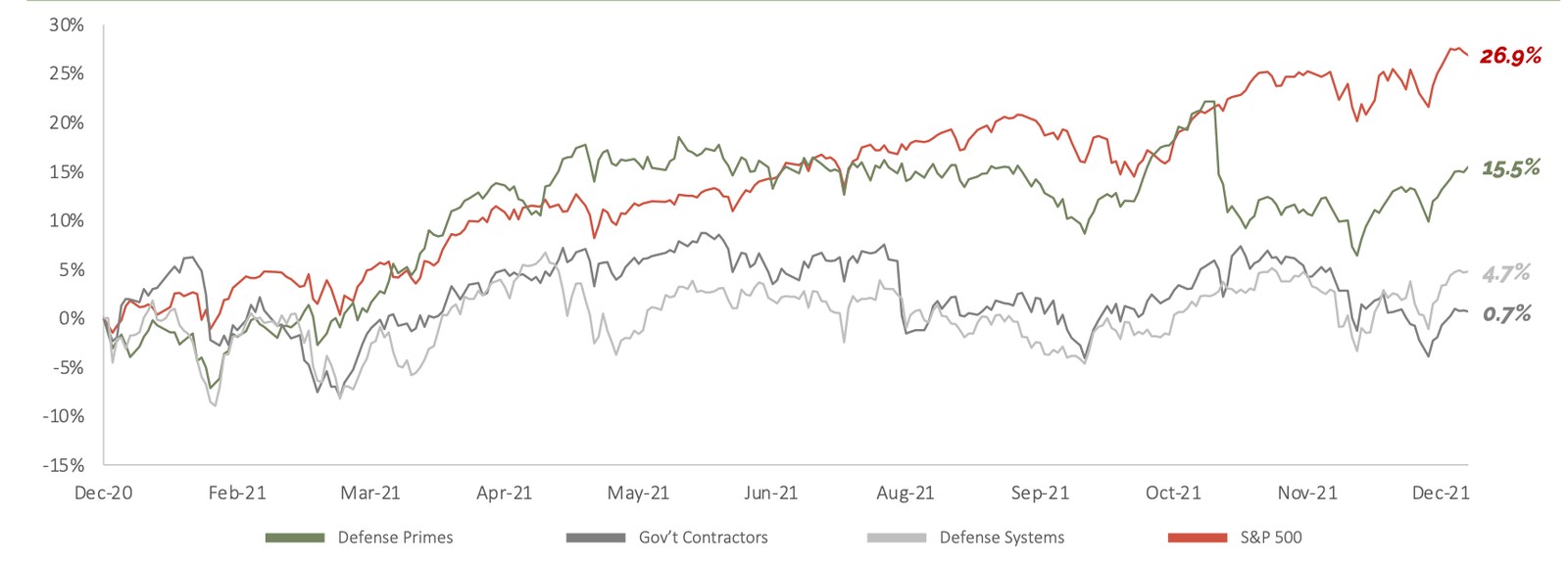
For much of the past twelve months, the TMG custom DGI indices have trailed the S&P 500 due to events including the Afghanistan withdrawal, growing Russia / Ukraine tensions, and a potential government shutdown, with extended funding leading to a partial recovery.
Historically, Defense Primes have had a greater exposure to the aerospace market relative to other DGI indices. As a result, Defense Primes have tracked the S&P 500 more closely during COVID as the overall market was tied largely to a return to normalcy and therefor a return of air travel.
DGI indices’ relative underperformance can be understood as a rebalancing; all DGI indices outperformed the S&P 500 in both 2019 and 2020.
Trailing Twelve Months (TTM) Public Equity Index
 Open page 7 of the report →
Transactions by Quarter
Select 2021 Transactions
(A) Announcement date. ND = not disclosed.
Physical & Cyber Security
2021 saw a large number of M&A transactions with many companies, particularly private equity firms, expanding their cybersecurity offerings to meet the increasing threat of cybersecurity attacks. Strategic buyers, partially driven by rising labor costs, have focused their M&A activity on cybersecurity and security technology targets to develop a full suite of security offerings.
The FBI published its 2020 internet crime report in March 2021. Per the report, the FBI saw a 69% increase of complaints in 2020 compared to 2019. Total losses related to internet crime grew from $3.5B in 2019 to $4.2B in 2020. Complaints of phishing-related crimes more than doubled in 2020 with losses related to compromised corporate email phishing totaling $1.8B in 2020. The increasing prevalence of attacks and losses related to targeting personnel within an organization will remain an ongoing focus of security professionals. The FBI also noted thousands of complaints from individuals and businesses pertaining to the CARES Act stimulus funds, specifically targeting unemployment insurance, PPP loans, and Small Business Economic Injury Disaster Loans (EIDL).
Cyber criminals have recently begun targeting the infrastructure sector and interfering with operations. Sizeable breaches include: On March 21, a criminal organization gained access to the networks of the computer manufacturer, Acer. The organization demanded a $50M ransom payment to avoid the publishing of the compromised data. Puerto Rico’s primary power distributor suffered a cyber attack that left >900,000 people without power. The denial-of-Service (DoS) attack flooded servers with close to 2 million hits per second.
Chip shortages and 5G threaten to disrupt smaller alarm and security services firms. Many security service and alarm companies provide systems to their commercial and residential customers that communicate using 3G technology. AT&T has announced it would phase out 3G service in Feb. 2022 to free up the spectrum range for 5G, while Verizon is giving customers until the end of the calendar year (2022). For many security and alarm companies, this trend means their equipment will not have a connection after February 2022. The systems can be updated to utilize 5G, however chip shortages have made it difficult for smaller security and alarm providers to procure the equipment needed to update systems.
The October job openings and labor report revealed a record 4.3M American workers quit their jobs in August and the number of job openings is just slightly down from the July high of 10.4M. The shortage of laborers has led businesses, including security services, to take dramatic measures to attract talent. In a survey conducted by Morgan Stanley, 51% of business owners noted job openings they could not fill, and 42% of companies said they have raised compensation as a result. Rising labor costs, which comprise around half of S&P 500 companies’ expenses, have compressed corporate profits, particularly for in person security service providers.
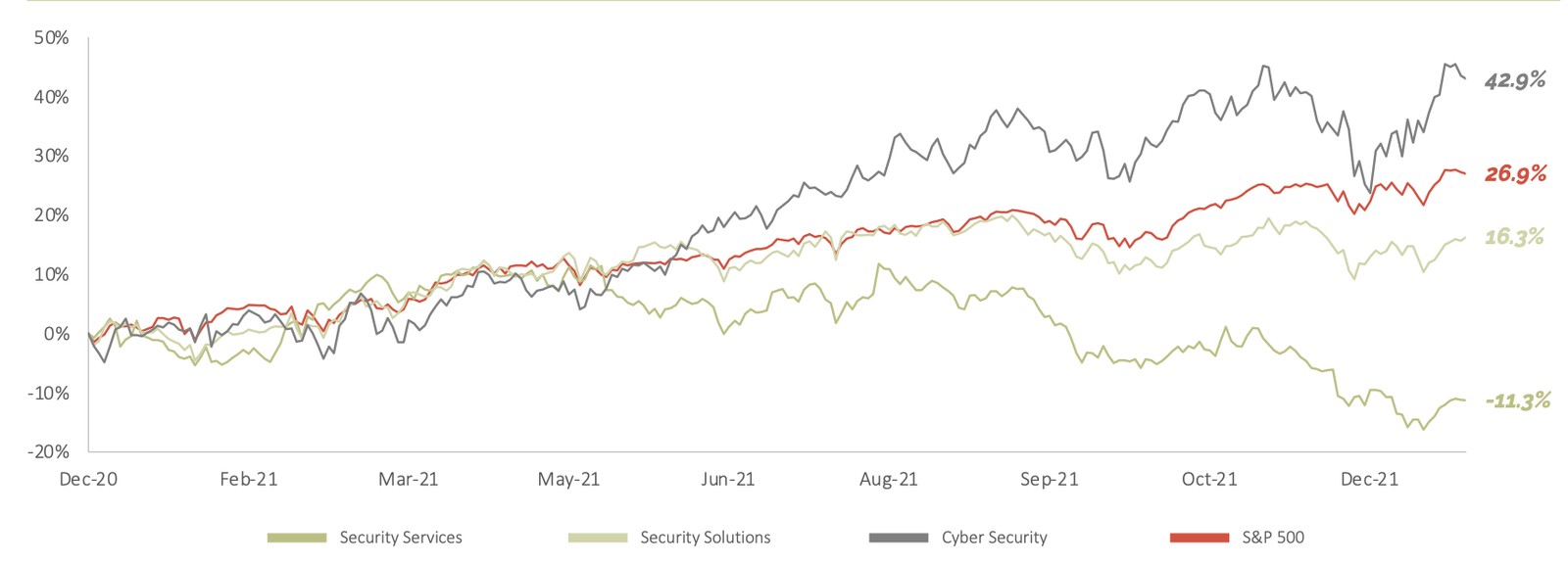
The Cyber Security index has outperformed the S&P 500 as organizations look to defend themselves from the increasing threat of cyber attacks.
The Security Solutions index had tracked the S&P 500, performing strongly alongside the market for much of the year. However, recent labor shortages have negatively impacted operations.
Security Services have underperformed in Q4 as a result of the rising cost of employment, labor shortages, and the recent spread of the COVID-19 Omicron variant, which threatens key industries including travel.
Trailing Twelve Months (TTM) Public Equity Index
 Open page 15 of the report →
Transactions by Quarter
Select 2021 Transactions
(A) Announcement date. ND = not disclosed.
Critical Infrastructure
The critical infrastructure industry experienced a large increase in M&A activity during 2021 as COVID related restrictions, which limited on-site visits, were lifted and dry powder for infrastructure funds increased. 2021 M&A largely focused on industries benefiting from government infrastructure investments as well as sectors rebounding from the pandemic including oil, gas, and aviation.
Through the initial months of his administration, President Biden made it clear that he planned to increase focus on renewable energy spending and curb oil consumption. On his first day in office, President Biden revoked the Keystone XL Pipeline’s permit, a clear sign that the oil industry will not receive the same level of support that it did under the Trump Administration. At the same time, President Biden has set the goal of 100% renewable energy in the power sector by 2035. This endeavor will require massive investment, with WIRES estimating that it will cost $30.0B - $90.0B to build the necessary transmission infrastructure alone.
On July 9th, President Biden signed an executive order meant to limit the dominance of large corporations. The order specifically targeted combating the impact of consolidation within the ocean shipping and railroad industries. The executive order encourages the Surface Transportation Board to mandate reciprocal or competitive switching and also asks the maritime commission to take steps to reduce the ability of large shipping companies to charge high fees. The executive order illustrates the Biden administration’s opposition to consolidation within the critical infrastructure industry, which has the potential to hamper M&A. However, President Biden asserts that his administration’s actions will benefit small and medium sized companies.
The U.S. Department of Transportation has selected 24 transportation infrastructure projects in 18 states to share $905.3M of funding in the latest round of its popular Infrastructure for Rebuilding America (INFRA) grant program. These grants provide a portion of the project costs and are further funded by local governments. This round of grants targeted areas of historical under investment, such as rural areas, which received 44% of the funding.
Like many areas of the economy, the critical infrastructure industry continues to struggle with labor shortages. According to Associated General Contractors, 89% of contractors have difficulty finding craft workers. The construction industry labor force continues to lag pre-pandemic levels despite largely leveling off over the past year. The continued labor shortage within the critical infrastructure industry has the potential to hamper growth going forward.
Water rates have risen by 43% since 2012, and cities are having to raise rates to combat infrastructure inefficiencies in water and wastewater facilities. Earlier in December, the EPA began allocating funds over 5 years in the amount of $50.0B for water and wastewater infrastructure improvement.
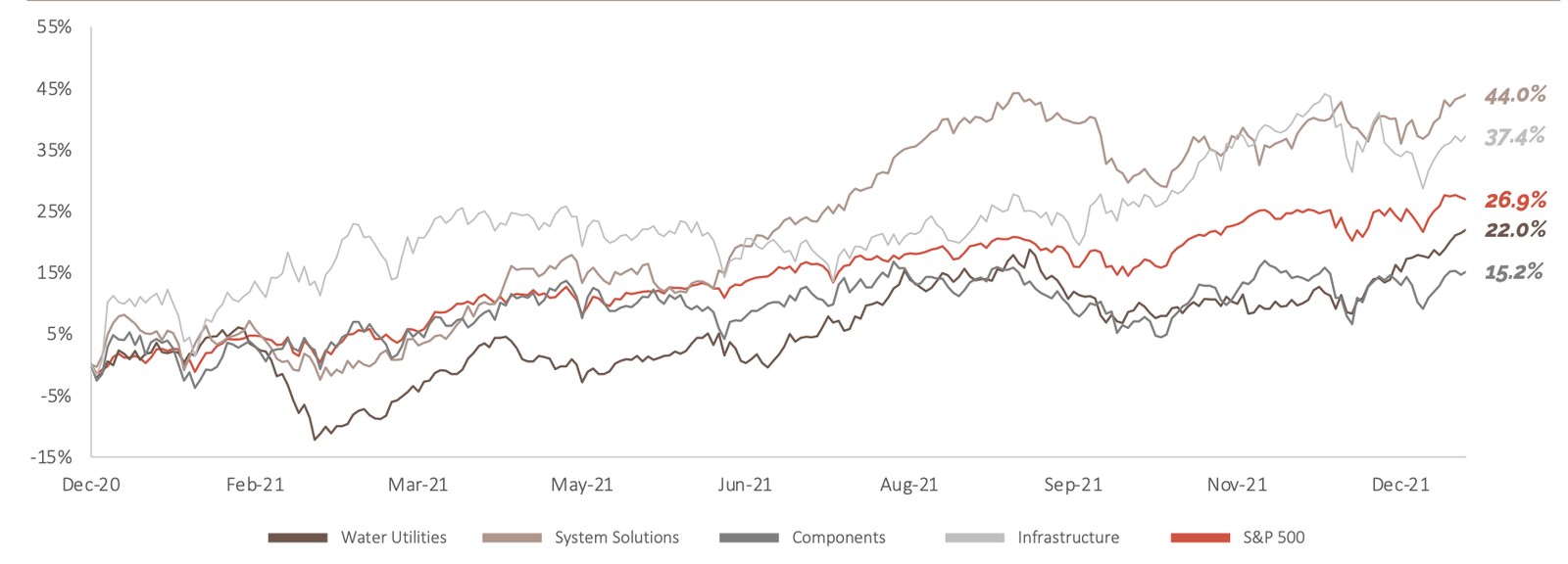
TMG’s Infrastructure and System Solutions indices largely tracked the S&P 500 for the first half of 2021, eventually outperforming the index due to tailwinds including the $1.2T bipartisan infrastructure bill passed by the Biden Administration in November 2021.
Utilities including the TMG custom Water Utility index have lagged the S&P 500 for the majority of 2021 due to the attractiveness of other assets including rising bond yields and investors’ shifted focus towards growth stocks linked to economic recovery.
Component suppliers have been negatively affected by rising input costs and supply chain shortages, causing the index to underperform.
Trailing Twelve Months (TTM) Public Equity Index
 Open page 23 of the report →
Transactions by Quarter
Select 2021 Transactions
(A) Announcement date. ND = not disclosed.
Maritime Transport & Facilities
Throughout 2021, many strategic and financial buyers placed a strong emphasis on supply chain efficiency. The cause for this focus seems to point to the logistical issues faced by many businesses. Acquirers are seeing the value in developing an omni-channel offering and cutting down on logistical delays. As seen from the top acquirers, supply chain progress is the main driver in the industry.
U.S. containerized imports continue to surge due in part to increased e-commerce activity as a result of the pandemic - U.S. containerized imports increased 23% YoY as of February 2021. Many U.S. ports became overwhelmed due to increased shipping, which led to delays. By November 2021, the time it took for a packaged to be shipped from Asia to the U.S. had increased 43% from the previous year.
The U.S. Department of Transportation Secretary announced the award of more than $241.0M through the Maritime Administration’s (MARAD) Port Infrastructure Development Program (PIDP). These grants demonstrate rapid action on commitments in the Biden-Harris Port Action Plan to strengthen our system and supply. These investments signify the importance of cleaner transportation and improving U.S. ports.
The shipping sector represents about 3% of total CO2 emissions, an amount that if unchecked could rise by as much as 50% by 2050. Noticing that some level of change is required, the International Maritime Organization (IMO) has mandated emission reductions of 50% for all vessels by 2050. Zero-emission fuels cost significantly more than conventional fuels, increasing the total cost of vessel ownership by 40% - 60%. In order to reach this goal, the industry will need to implement new strategies to accelerate decarbonization.
A variety of businesses and investors are looking for different shipping models to deal with the global supply chain issues. Some retailers have begun chartering their own ships due to high freight prices and limited capacity among shipping companies. Walmart hired its own ship in August while Home Depot did the same in June. Additionally, volatility in the sector has led to an increase in alternative financing methods including convertible debt, private equity capital, and sale-and-leaseback arrangements. The entrance of new businesses and investors into the shipping market presents the possibility for market disruption.
Growth of freight rates accelerated in mid-July as companies struggled to meet strong consumer demand for goods as a result of continued global supply chain issues. At the end of September 2021, the Freightos Baltic Index had increased 214% over the course of 2021 and is roughly 8x higher than it was pre-pandemic in March 2020. Freight rates are currently the highest they have been in over a decade, which has caused an increased demand for ships. Additionally, purchases of dry bulk carriers reached record levels for the year in Q3.
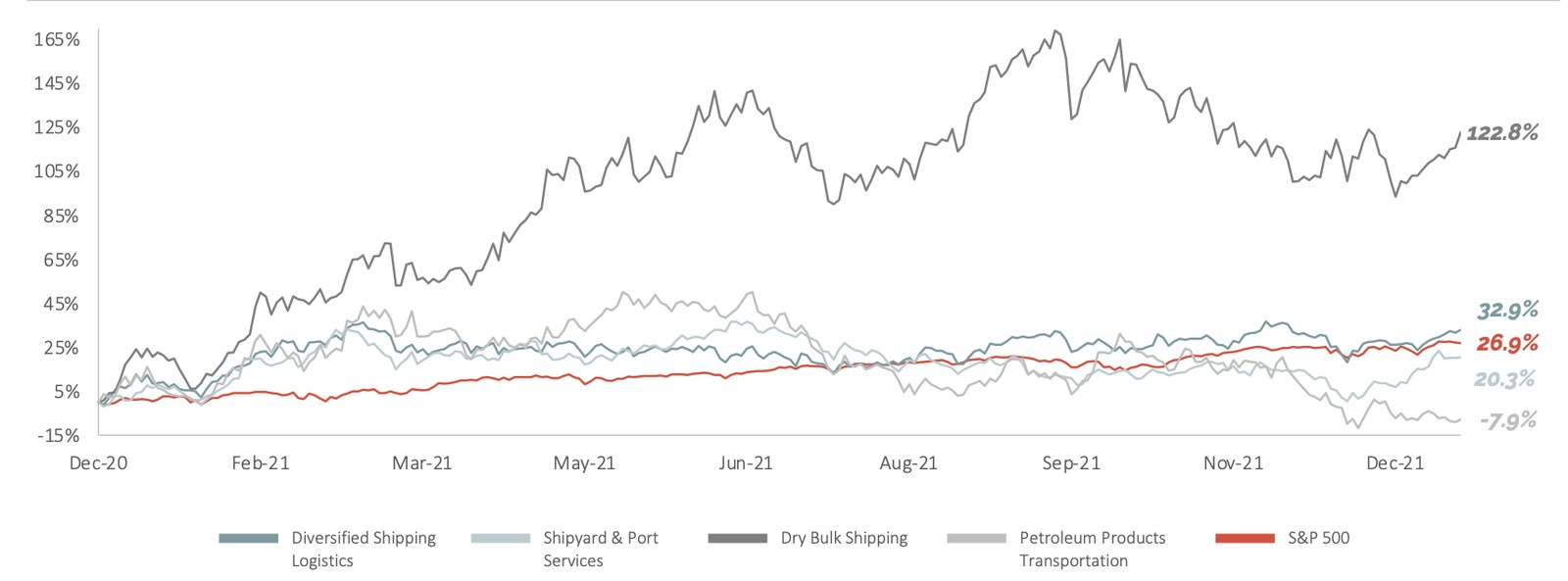
TMG’s Dry Bulk Shipping index and to a lesser degree Diversified Shipping Logistics, outperformed the S&P 500 by a wide margin due to COVID related port delays that drove higher freight rates and record-breaking profits for the industry. These market catalysts had an opposite impact on the port and shipyard industries, which saw lower than usual port activity, leading to a decline relative to the overall market.
Petroleum Products Transportation companies tracked the S&P 500 for the first half of 2021, eventually declining as investors feared the spread of new COVID variants and associated lockdowns, which would ultimately reduce demand for transportation fuels.
Trailing Twelve Months (TTM) Public Equity Index
 Open page 32 of the report →
Transactions by Quarter
Select 2021 Transactions
(A) Announcement date. ND = not disclosed.
Read the 2021 Year in Review
Speak With the Team
Download the Full 2021 Year in Review
Complete deal tables, valuation multiples, public company comps, and contract awards across all four sectors.
The information provided in this newsletter is for informational purposes only and does not constitute an offer to sell or the solicitation of an offer to buy any of the securities mentioned herein. Past performance does not guarantee future results. None of the information or analyses presented are intended to form the basis for any investment decision, and no specific recommendations are intended. Any performance mentioned does not include transaction fees and costs, which would reduce an investor's return. An investment cannot be made directly in these custom market indices. Public market valuation multiples are provided for reference purposes only and reflect traded equity values, which may differ materially from private company transaction pricing.
The logos and company names used in this report are for illustration purposes only, and the report is not associated with or supported by the owners of the trademarks.
© 2026 The McLean Group. All rights reserved. Securities transactions are conducted through McLean Securities, LLC, a member of FINRA/SIPC.