

2022 Year in Review
Defense, Government & Intelligence | Security | Critical Infrastructure | Maritime
Download Full Report
Year in Review
TMG Overview
- The McLean Group is a 25-year-old boutique investment bank and financial services firm focused on the A) Defense, Government & Intelligence (DGI); B) Physical & Cyber Security; C) Critical Infrastructure; and D) Maritime Transport & Facilities markets. Our 60+ professionals bring deep industry experience and relentless execution to every client engagement. We provide solutions that blend financial creativity with operational expertise. Whether we are providing transaction advisory services, valuation opinions, or growth capital, our services are unmatched in these core markets.
- Our clients are special, and their missions are often vital to national security. They are required to be excellent at all times, and they expect the same from their transaction advisor.
- Our trusted team of financial professionals provides middle-market clients with transaction advisory services, business valuation services, and growth capital to help them reach their short and long-term goals.
- Key statistics: more than $6B in total transaction value since 2010; 25+ years supporting our clients; 145+ closed M&A engagements since 2010; 50+ professionals; 400+ annual valuation clients; 6 growth capital investments.
Alta Via Consulting acquired by cBEYONData
- cBEYONData, a portfolio company of Bluestone Investment Partners, acquired Alta Via Consulting, a premier provider of ERP consulting services centered around improving clients’ operations by maximizing value from existing business processes and information systems.
- The combined firm has over 240 employees delivering ERP architecture and design, business intelligence, financial management, cloud migration and robotic process automation solutions. The firm’s clients include the U.S. Army, the Department of Justice, and the General Services Administration, among others.
Compass Water Solutions acquired by CECO Environmental
- CECO Environmental acquired Compass Water Solutions, a leading global supplier of membrane-based, industrial water and wastewater treatment systems that help customers achieve regulatory compliance of water discharge at the lowest lifecycle cost.
- The transaction adds critical engineered solutions and an experienced leadership team to CECO’s growing industrial water capabilities. CECO expects the Compass acquisition to unlock greater value by leveraging CECO’s international sales resources, existing US Navy expertise, global engineering and production footprint.
Wastech Controls & Engineering acquired by Ovivo
- Ovivo acquired Wastech Controls & Engineering (“Wastech”), a specialist in turn-key packaged systems for industrial wastewater treatment applications for numerous industrial markets. With over 1,500 installed systems, Wastech has specialized in turn-key systems for industrial wastewater treatment applications for numerous industrial markets.
- The integration of Wastech will enhance Ovivo’s systems offering in the US electronics market, as well as create cross-selling opportunities in other markets through Wastech’s well established client base.
Groundswell Consulting Group acquired by CollabraLink
- CollabraLink, a portfolio company of Washington Harbour Partners, acquired Groundswell Consulting Group (“Groundswell”), a leading provider of Appian development and integration services to US federal agencies. The integrated company assumed the name Groundswell.
- The merger with Groundswell expands CollabraLink’s footprint through federal civilian and defense agencies, and solidifies CollabraLink as the largest, most accomplished Appian integrator in the public sector.
Counter Threat Solutions acquired by SilverEdge Government Solutions
- SilverEdge Government Solutions (“SilverEdge”), a portfolio company of Godspeed Capital Management (“Godspeed”), acquired Counter Threat Solutions, LLC (“CTS”), a leading provider of all source and counterintelligence analysis, identity intelligence, and enterprise IT and data management solutions, which include sophisticated software development and engineering and niche ServiceNow capabilities.
- The transaction increases SilverEdge’s cleared workforce to approximately 450 engineers and technical staff.
CHEMetrics acquired by AquaPhoenix Scientific
- AquaPhoenix Scientific, a portfolio company of Incline Equity Partners, acquired CHEMetrics, a manufacturer of water analysis test kits and instrumentation using self-filling reagent ampoules for efficiency and safety. CHEMetrics has served the industrial water, petroleum refining, chemical process, food and beverage, power generation and other water treatment industries since 1969.
- The acquisition of CHEMetrics marks a step in AquaPhoenix’s growth strategy of acquiring businesses aligned with its core competencies to help the company best service its customers.
Defense, Government & Intelligence
Includes defense, intelligence, and federal civilian contractors as well as providers of diversified government services related to IT and consulting services that help support mission critical, core operational, and administrative functions of government agencies.
The long-awaited JWCC contract decision is in. The DoD’s cloud services contract debacle has finally come to an end after over four years of deliberation. In mid-December, the Pentagon announced it has chosen four cloud providers including Microsoft, Google, Oracle, and Amazon Web Services. The contract is expected to provide the DoD with “enterprise wide, globally available cloud services across all security domains and classification levels, from the strategic level to the tactical edge.” JWCC is expected to run through June 2028 and has an estimated ceiling of $9 billion.
The Taiwan Policy Act of 2022 was passed by the Senate Foreign Relations Committee on September 14th. If signed, the bill would allocate $6.5B in foreign military assistance to Taiwan with the U.S. promising to provide resources for both land and sea-based attacks.
On August 16th, President Biden signed the Inflation Reduction Act into law which was a major accomplishment for the administration and Democrat party. The bill marks the single largest investment in combating climate change in U.S. history, lowers the costs of prescription drugs, and raises corporate taxes. A few of the law’s key provisions include the enactment of a 15% minimum corporate tax rate, prescription drug price reform, IRS funding, Affordable Care Act (ACA) extension, and investments in climate change / clean energy.
The U.S. Army has released its Army Climate Strategy Implementation Plan which provides the blueprint for an enterprise-wide adaption and mitigation measures through FY27. The plan is set to reduce gas emissions from Army property by 10% by the end of FY23, and by 40% by the end of FY27.
On February 24th, Russia launched a military invasion of Ukraine in a steep escalation of the Russo-Ukrainian war. Shortly after the invasion, President Biden signed the bipartisan Ukraine Supplement Appropriations Act to provide an additional $13.6B in military, humanitarian, and economic assistance to Ukraine. As of the end of 2022, it is estimated that the U.S. has directed nearly $50B in assistance to Ukraine, with approximately $23B being military related. The U.S and its allies have imposed a wide range of sanctions on Russia including imports of items such as semiconductors and exports on certain goods and services.
The FTC sues to block Lockheed Martin’s $4.4B acquisition of Aerojet Rocketdyne. The agency was concerned that Lockheed would use its control of Aerojet to harm rival defense contractors and further consolidate multiple markets critical to national security and defense. Lockheed subsequently terminated its attempt to acquire the Company. As a result, L3Harris is currently under LOI to purchase Aerojet and will seek to gain regulatory approval in early 2023.
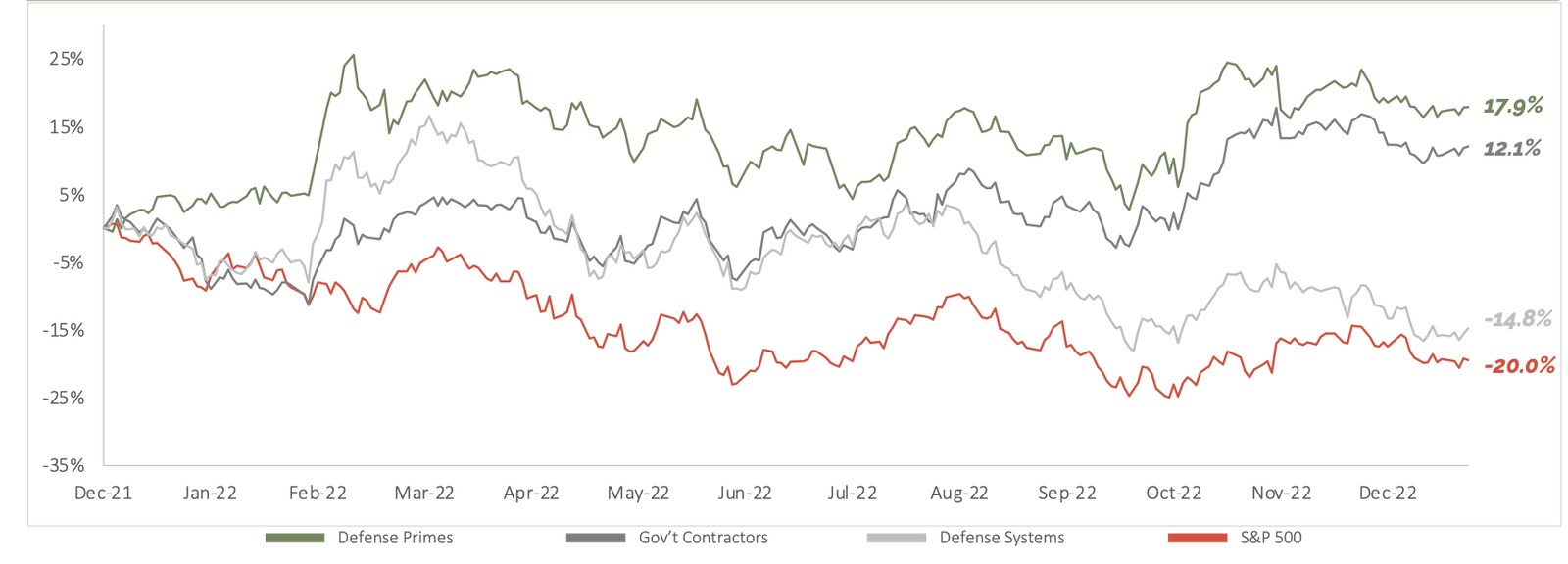
Over the past twelve months, the TMG custom DGI indices have largely outperformed the S&P 500 due to various events including the Russia / Ukraine conflict, continued interest rate hikes from the Federal Reserve to curb inflation, and ongoing North Korean nuclear missile testing
The S&P 500 recorded one of the worst years in history with 2022 being only the 5th calendar year of negative returns in the last 40+ years
Despite the tough year for the broader equity market, 2022 remained quite strong for DGI equities, specifically “Defense Primes” who saw a substantial spike in contract awards given the geopolitical landscape, and finished the calendar year up 17.9%
Despite the 2022 M&A regression on the broader level, the DGI industry remained quite strong. There were several landmark transactions in the industry including Carlyle’s purchase of ManTech, the combination of Vectrus and Vertex forming V2X, and the announcement of L3Harris’ acquisition of Aerojet Rocketdyne. The middle market platform companies continued to be quite active as private equity firms looked to acquire unique capability sets and deploy newly raised funds.
Trailing Twelve Months (TTM) Public Equity Index
 Open page 7 of the report →
Transactions by Quarter
EBITDA Valuation Multiples
Multiples reflect public company trading values as of December 31, 2022 and are provided for reference purposes only. Public market multiples may differ materially from private company transaction pricing.
Select 2022 Transactions
(A) Announcement date. ND = not disclosed.
Physical & Cyber Security
Encompasses firms that ensure physical security, digital security, and technology risk management. Areas such as security operations, threat intelligence, vulnerability analysis, and security data integration/visualization are of particular interest.
Healthcare continued to be a prime target for cyber attacks in 2022. 90% of the ten largest healthcare data breaches reported in 2022 were caused by third-party vendors. Notable breaches include:
OneTouchPoint: 4.11 million patients in what is considered to have been the most major breach of 2022 over 4.11 million patient records were affected by a ransomware attack on printing and mailing vendor OneTouchPoint on April 28. The largest affected third-party vendor was Aetna with over 326,000 patients impacted.
Eye Care Leaders: Roughly 3.6 million patients Eye Care Leaders’ reported ransomware attack and the drama that ensued is the second-largest breach reported in 2022.
Advocate Aurora Health: 3 million patients was the second major U.S. health system to report unauthorized disclosure due to the use of Pixel which continues to defend itself through multiple class-action lawsuits. The breach was reported in late October as Advocate Aurora informed patients that their health information was shared with Facebook and Google as a result of its usage of Pixel.
Connexin Software: 2.2 million patients a major pediatric electronic medical records company, indicated over 119 provider offices and over 2.2 million patients were impacted
Cyber insurance rates skyrocketed to high levels. While many kinds of insurance lines saw premium increases in 2022 the increases of cyber insurance rates were unprecedented. Cyber insurance rates increased by an average of 28% in the first quarter of 2022 compared with the fourth quarter of 2021. One of the leading reasons for this increase is a decreased appetite for risk on the carrier side for cyber risks. On the flip side, high demand is sparked by the greater awareness companies have for cyber risks today more so than ever before. One of the ways underwriters have begun mitigating risks is by requiring multi-factor authentication. Regarding a specific sector, insurers became weary of insuring the energy & critical infrastructure sectors’ cyber risks in 2022 due to the vulnerability associated with non-robust cyber protocols in the industry.
The growing work-from home population continues to pose a major challenge to the cybersecurity industry. Despite the noise around employers requiring employee presence at the office in 2022, data suggests remote workers are here to stay at ~27 million people. This has drastically increased the attack surface with widespread use of operational technology outside work environments. When enterprises were less dispersed the attack surface was smaller and posed less of a concern than it does in today’s remote world.
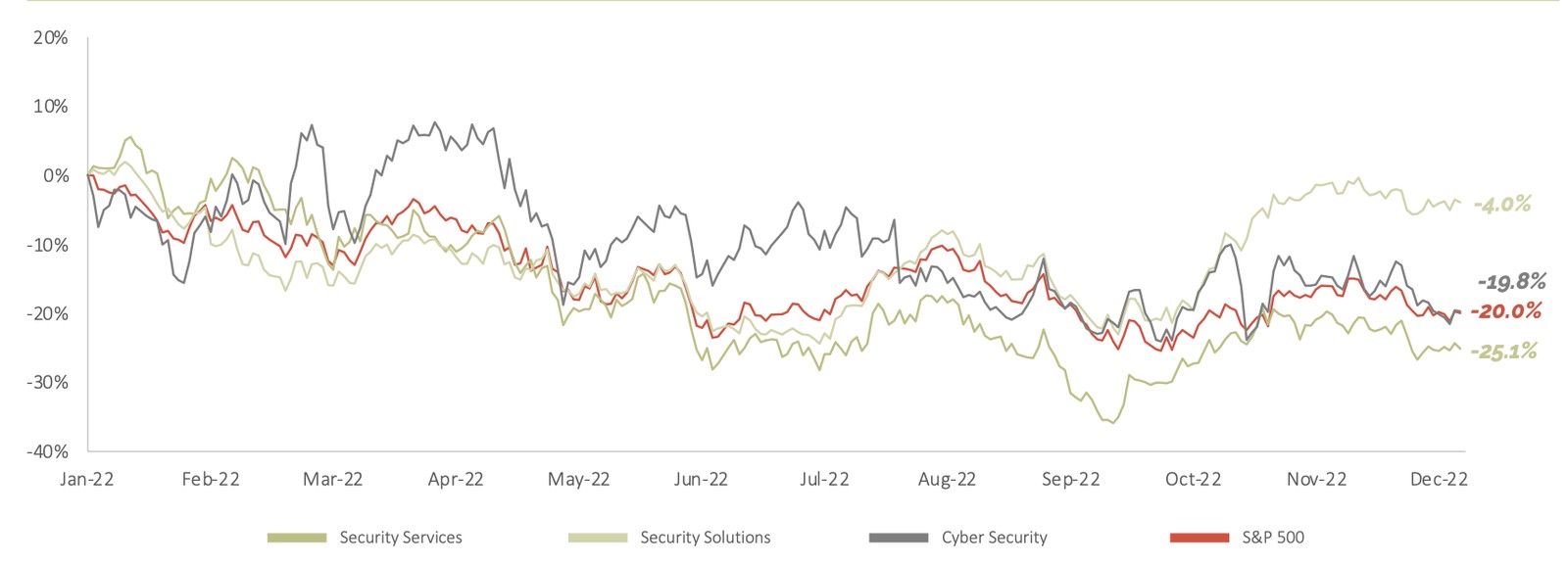
All indices have finished negative in the last twelve months due to market volatility, declining company earnings potentially driven by higher interest rates
The Security Solutions index declined the least, beating out the S&P 500 due to its defensive nature
The Cyber Security index declined more than the S&P 500 largely driven by the technology exposure of these companies with valuations declining across the NASDAQ
2022 saw a large number of M&A transactions with many companies, particularly private equity firms and their portfolio companies such as Warburg Pincus – Allied, expanding their cybersecurity offerings to meet the increasing threat of cybersecurity attacks. Strategic buyers, have focused their M&A activity on cybersecurity and security technology targets to develop a full suite of security offerings.
Trailing Twelve Months (TTM) Public Equity Index
 Open page 14 of the report →
Transactions by Quarter
EBITDA Valuation Multiples
Multiples reflect public company trading values as of December 31, 2022 and are provided for reference purposes only. Public market multiples may differ materially from private company transaction pricing.
Select 2022 Transactions
(A) Announcement date. ND = not disclosed.
Critical Infrastructure
Comprised of firms that provide solutions, components, and services to the commercial, industrial, municipal, and agriculture markets. This sector is less volatile and will see fewer ebbs and flows as the market fluctuates.
Price hikes caused by inflation are taking a toll on infrastructure projects in America due to the decrease in real value of the $1 trillion infrastructure plan President Biden signed in 2021. The Infrastructure Investment and Jobs Law, among other initiatives, will deliver clean water and eliminate lead service lines, provide increased access to high-speed internet, repair roads and bridges, invest in public transit, build a national EV charging network, and upgrade energy and cybersecurity infrastructure.
Russia’s invasion of Ukraine had significant impact on global supply chains, most notably on the production and export of oil. As the 3rd largest global oil producer (12% of global supply in 2021), Russia’s invasion of Ukraine and the subsequent sanctions by Western Nations greatly disrupted global oil supply causing oil prices to spike to almost $130/barrel in March of 2022. Public outcry in the U.S. over record high gas prices which passed a national average of $5/gallon, paired with existing inflation fears caused political leaders to take dramatic steps to curb rising gas prices including releasing strategic oil reserves, reissuing production licenses for U.S. oil companies in Venezuela, and temporarily suspending gas taxes (a large source of funding for transportation infrastructure). These steps, in addition to recession concerns reducing demand led to a decrease in oil prices to $75/barrel by December.
In an effort to sanction Russia for its invasion of Ukraine and reduce the Nation’s ability to finance its military efforts, the United States and its Western Allies have dramatically reduced their consumption of Russia oil with the U.S. banning imports entirely. Sanctions have been harder to implement for European nations which in 2021 consumed over half of all Russia crude oil imports. The reduction in oil supply has caused wholesale energy prices to increase 15-fold from early 2021 across parts of Europe, causing public outcry and political instability.
The EU has increased security measures on its energy infrastructure following the sabotage of two subsea Russia to EU pipelines in September. A perpetrator remains undetermined but most European nations suspect the incident was a result of an attack given the bitter energy standoff between the EU and Russia.
On August 16, 2022, President Biden signed into law the “Inflation Reduction Act,” intended to fight growing inflation which reached over 7% YoY in November of 2022. The law also provides mechanisms to invest in domestic energy production and manufacturing, reduce carbon emission by roughly 40% by 2030, and allow Medicare to negotiate prescription drug prices.
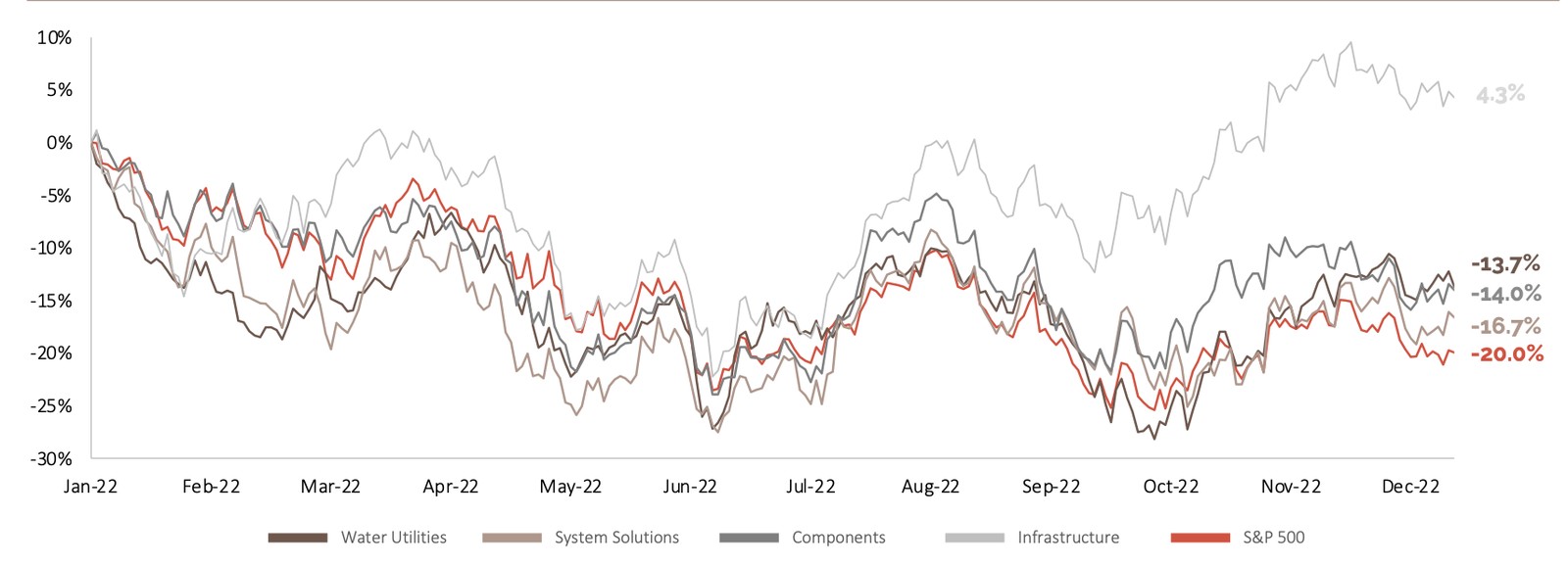
TMG’s indices have very closely tracked the ups and down of the S&P 500 throughout 2022 while slightly outperforming the benchmark
The critical nature of the infrastructure industry as well as its reliance on steady government funding is a reason investors largely consider the industry “defensive” and rotate into the sector during times of economic uncertainty
Rising interest rates and recession fears buoyed the critical infrastructure industry with the most defensive subsectors such as the utilities outperforming the most. TMG’s infrastructure index was aided by anticipated government funding
After a record-breaking year, 2022 witnessed a relatively minor reduction in acquisitions as strategic and financial investors alike continued to invest in a defensive industry with growing government investments. Both strategic and financial sponsors pursued large acquisitions in developing sectors with significant growth opportunities including data centers and renewable energy.
Trailing Twelve Months (TTM) Public Equity Index
 Open page 22 of the report →
Transactions by Quarter
EBITDA Valuation Multiples
Multiples reflect public company trading values as of December 31, 2022 and are provided for reference purposes only. Public market multiples may differ materially from private company transaction pricing.
Select 2022 Transactions
(A) Announcement date. ND = not disclosed.
Maritime Transport & Facilities
Includes maritime shipping and transportation firms as well as related facilities and vessels. This includes firms that are involved in both “blue water”, which includes ocean trade, and “brown water,” which includes rivers and coastal trade.
Container spot rates have risen and fallen dramatically in the last three years. The especially steep increase in 2021 due to COVID-related supply chain disruptions caused shipping rates to reach a historical high of nearly $10,400 USD in September of 2021. By November of 2022, the global fright rate index stood at $2,400 USD, a decrease of over 75% from just one year earlier.
The dramatic decrease in spot rates (which are used to determine the freight rates in just 10% of ocean cargo) has had little impact on the bottom lines of container shipping companies whose terms are governed by contracts negotiated directly between carrier and cargo shipper which have increased rates in 2022. The dual impact of falling oil prices and rising contract rates have resulted in record high profits for container shipping companies which is expected to reach $256 billion for 2022.
The container shipping industry’s record-breaking profits in 2022 have drawn criticism from both workers and politicians considering the industry’s outsized impact on inflation – the International Monetary Fund estimates that the increase in shipping costs observed in 2021 alone increased 2022 inflation by 1.5%.
In the UK, dock workers upset that inflation is outpacing wage gains have gone on strike at some of the nation’s largest ports and caused further supply chain disruptions. In and effort to address public outrage and control global inflation, political leaders have introduced legislature targeting the shipping industry. In July of 2022, France’s National Assembly narrowly rejected a tax on windfall profits by energy and transportation companies while in the U.S. President Biden signed the Ocean Reform Act which empowers the Federal Maritime Commission to prevent carriers from unreasonably denying unused cargo space to U.S. exports and to investigate late fees charge by container lines.
Marine Money hosted a successful finance forum in November 2022. A theme running through the many speeches, presentations and panel discussions was the strong recovery in offshore oil and marine petroleum transport markets. As oil prices have risen and demand has firmed up, offshore service vessel day rates and utilization factors have elevated rapidly. American marine industry CEO’s and analysts predict robust growth through 2023, despite warnings of a global economic slowdown. There was also a great deal of discussion surrounding the development of offshore wind projects, which could boost maritime shipyards and operators in the U.S. in the next few decades.
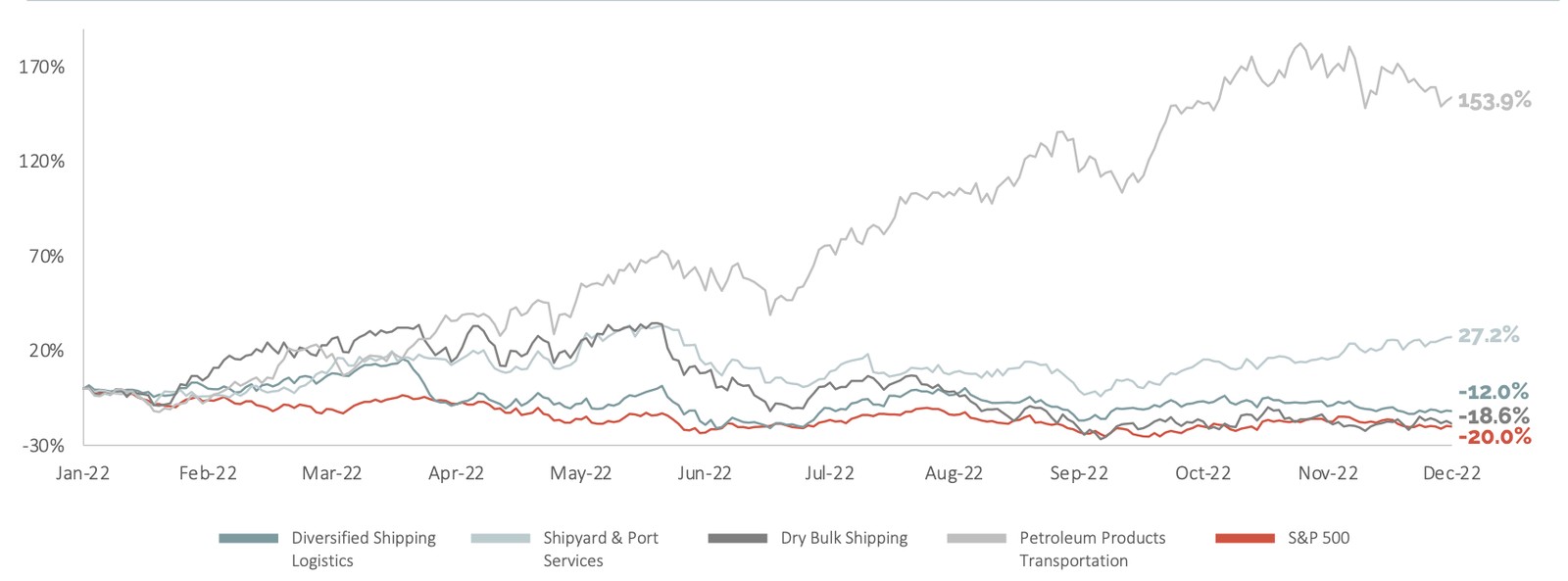
The petroleum products transportation industry massively outperformed TMG’s other indices on account of historically high charter rates as geopolitical tensions associated with the Russia/Ukraine war caused higher insurance premiums and longer shipping routes for oil cargo
Both TMG’s shipping logistics and dry bulk shipping indices largely tracked the S&P 500 in 2022 ending down 12.0% and 18.6% respectively on account of global macro economic pressures including increased interest rates and an anticipated recession dragging down global shipping
The Shipyard and Port Services industry outperformed the S&P in H2-2022 as rates and utilization remained high across the industry
Throughout 2022, many strategic buyers focused their acquisition efforts on shoring up their supply chain resiliency and flexibility. Large shipping companies such as Maersk and MSC continued their vertical integration strategy by acquiring logistics companies to support their end-to-end offering.
Trailing Twelve Months (TTM) Public Equity Index
 Open page 30 of the report →
Transactions by Quarter
Select 2022 Transactions
(A) Announcement date. ND = not disclosed.
Read the 2022 Year in Review
- Jun 2023Monthly Middle Market M&A Insider Report (May 2023)
- Apr 20231st Quarter 2023 M&A Market Update
- Apr 2023Monthly Middle Market M&A Insider Report (April 2023)
- Oct 20223rd Quarter 2022 M&A Market Update
- Jul 20222nd Quarter 2022 M&A Market Update
- Apr 20221st Quarter 2022 M&A Market Update
Browse every 2023 post in the archive →Planning a sale or acquisition? See our M&A advisory and valuation services.
Speak With the Team
Download the Full 2022 Year in Review
Complete deal tables, valuation multiples, public company comps, and contract awards across all four sectors.
The information provided in this newsletter is for informational purposes only and does not constitute an offer to sell or the solicitation of an offer to buy any of the securities mentioned herein. Past performance does not guarantee future results. None of the information or analyses presented are intended to form the basis for any investment decision, and no specific recommendations are intended. Any performance mentioned does not include transaction fees and costs, which would reduce an investor's return. An investment cannot be made directly in these custom market indices. Public market valuation multiples are provided for reference purposes only and reflect traded equity values, which may differ materially from private company transaction pricing.
The logos and company names used in this report are for illustration purposes only, and the report is not associated with or supported by the owners of the trademarks.
© 2026 The McLean Group. All rights reserved. Securities transactions are conducted through McLean Securities, LLC, a member of FINRA/SIPC.