


2024 Year in Review
Defense, Government & Intelligence | Security | Critical Infrastructure | Maritime
Download Full Report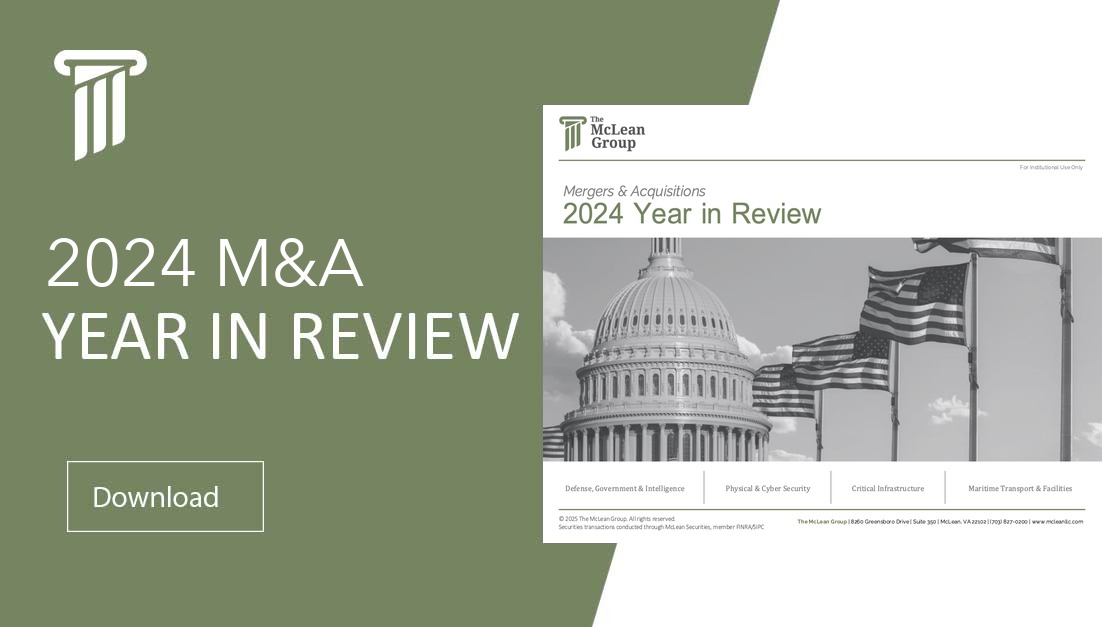
Year in Review
Microtel acquired by Tyto Athene
- Tyto Athene, a portfolio company of Arlington Capital Partners, acquired Microtel, a space software development and flight support services provider to mission-critical space programs.
- The acquisition added 40 highly-skilled employees to Tyto Athene’s workforce and expanded their real-time mission-critical flight software, ground system software, and science data processing capabilities. Microtel also allowed Tyto Athene to expand their presence within NASA, United States Space Force, National Security Agency (NSA), and the DoD.
Quintron Systems acquired by SAS
- Special Aerospace Services (“SAS”), a portfolio company of Godspeed Capital, acquired Quintron Systems, a trusted provider of communications technology solutions for aerospace, defense, and critical infrastructure clients.
- SAS specializes in spaceflight engineering and hardware with a full-cycle solution portfolio that includes tactical engineering support, avionics, systems, safety, and launch integration solutions. The acquisition aligned with SAS’s strategic objectives within NASA and other commercial clients who rely on Quintron’s Voice-over-IP (VoIP) solutions.
Emagined Security acquired by Neovera
- Neovera, a portfolio company of 424 Capital, acquired Emagined Security, a leading provider of professional services for information security and compliance solutions in highly regulated industries.
- Emagined Security’s proven track record of success providing penetration testing, vulnerability assessment, threat intelligence, security operations consulting, and incident response solutions will help Neovera address the cybersecurity challenges faced by their customers, especially within the financial, healthcare, and government markets.
Dignari acquired by EY
- Ernst & Young (“EY”) acquired Dignari, a provider of strategic planning, systems development, and leadership consulting for private sector and U.S. federal government security programs.
- Dignari brought approximately 300 highly-qualified employees to EY’s industry-leading Americas Government & Private Sector practice. The acquisition provided EY access to the Company’s performance history, extensive customer relationships within both the government and commercial sectors, and desirable identity and access management (IAM) capabilities.
Defense, Government & Intelligence
Includes defense, intelligence, and federal civilian contractors as well as providers of diversified government services related to IT and consulting services that help support mission critical, core operational, and administrative functions of government agencies.
On August 23, the U.S. Small Business Administration (SBA) proposed a new rule regarding small businesses that make disqualifying size / status recertifications. The rule has significant implications for small business M&A and the ability of small businesses to continue performing on certain set-aside work after a disqualifying recertification.
On December 17, the SBA made its final ruling, which included the following changes to become effective January 16, 2025: new minority controls for investors in 8(a), woman-owned, and service-disabled veteran-owned small business (SDVOSBs) that allow minority investors to block “extraordinary” decisions related to equity ownership, dissolution, bankruptcy, and M&A; and changes to recertification rules that would make small businesses that recertify as “Other Than Small” ineligible to receive future Task Orders (TOs) or have option years exercised on multiple-award set-aside contracts (including GSA Schedule contracts). The changes include an exception for recertifications after small-to-small M&A and would not go into effect until January 17, 2026, one year after the effective date for the other rule changes.
The Biden administration recently notified Congress of an $8 billion weapons package for Israel which will be the largest the U.S. government has authorized since the $20 billion weapons package shortly after the beginning of the conflict with Hamas in 2023. The package will consist of thousands of bombs, missiles, and artillery shells, and precision munitions. $6.75 billion is allocated to fund two different precision kits, small diameter bombs and 2,000-pound bombs.
On December 23, 2024, President Biden signed the FY 2025 National Defense Authorization Act (NDAA) into law. This authorized $895.2 billion in funding for the Department of Defense and Department of Energy national security programs, a $9 billion increase over 2024.
The Department of Defense’s fiscal year 2025 budget offers significant insights for government contractors seeking to align with the department’s priorities. $143.2 billion will be allocated to research, development, test, and evaluation, with the purpose of enhancing innovation, modernization, technology advancements, and strengthening U.S. National Security.
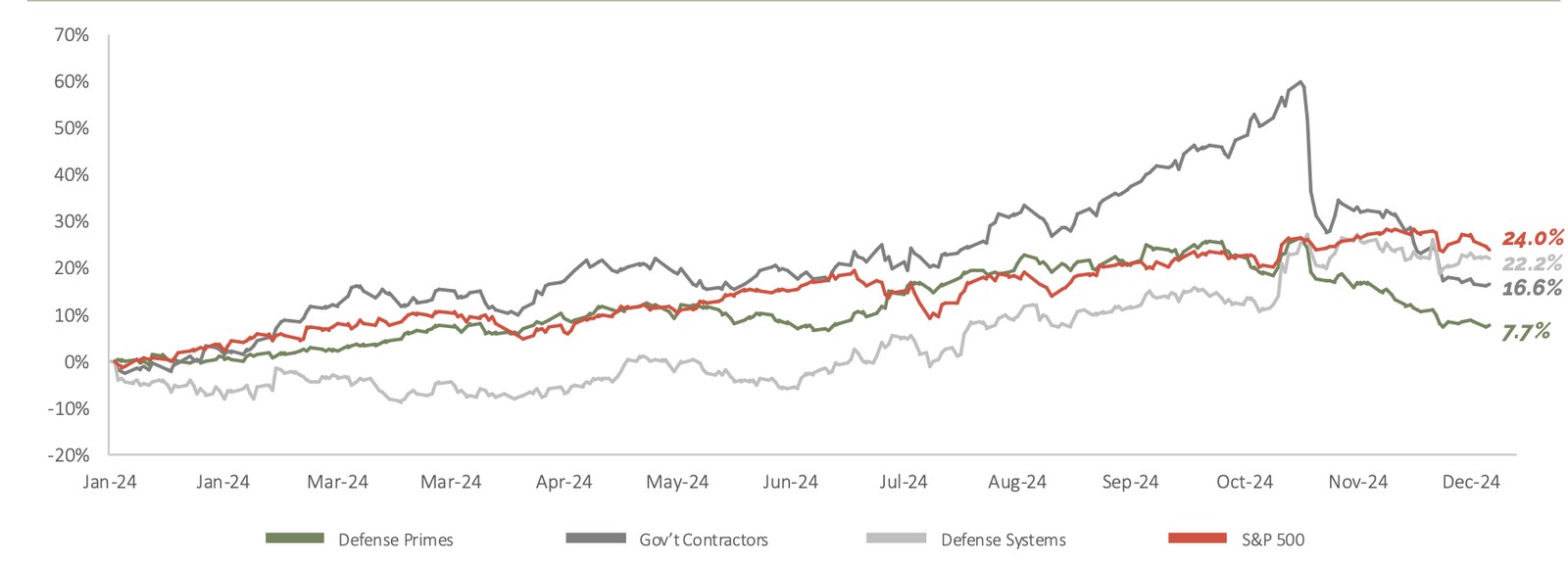
The S&P 500 soared 24% in 2024, fueled by enthusiasm for Artificial intelligence and the tech sector. The “Magnificent Seven” stocks drove over 50% of the S&P 500’s returns with NVIDIA and Tesla’s stock price rising 171% and 63%, respectively.
In September, the Fed cut interest rates by 50 basis points, marking the first rate cut since the onset of the COVID pandemic and the massive fiscal stimulus that followed. The Fed followed its aggressive first move with two further 25 basis point rate cuts in November and December.
With the result of the presidential election in early November, the Government Contractors index dropped precipitously amid fears of curtailed government spending and the Department of Government Efficiency (DOGE) initiative.
2024 DGI M&A Activity rebounded to levels in line with 2020 and 2021 after a slow 2023 by transaction count. CACI International (NYSE: CACI) was one of a handful of strategic acquirers that completed multiple transactions in 2024, completing two in October with a combined enterprise value (EV) of ~$1.6B. Arlington Capital Partners (ACP) and Godspeed Capital led financial buyers with 9 transactions completed in 2024, the former having announced the $4.4B EV sale of its BlueHalo platform to Aerovironment in November.
Trailing Twelve Months (TTM) Public Equity Index
 Open page 7 of the report →
Transactions by Quarter
EBITDA Valuation Multiples
Multiples reflect public company trading values as of December 31, 2024 and are provided for reference purposes only. Public market multiples may differ materially from private company transaction pricing.
Select 2024 Transactions
(A) Announcement date.
Physical & Cyber Security
Encompasses firms that ensure physical security, digital security, and technology risk management. Areas such as security operations, threat intelligence, vulnerability analysis, and security data integration/visualization are of particular interest.
Artificial Intelligence (AI) and machine learning (ML) technologies continue to transform cybersecurity in 2024. Businesses leveraging AI for threat detection and prevention reported saving an average of nearly $2.7M per breach according to IBM. However, cybercriminals are also utilizing AI to develop automated phishing campaigns and identify system vulnerabilities, further escalating the arms race in cybersecurity.
The federal government issued the final rule for the Cybersecurity Maturity Model Certification (CMMC) on October 15, setting stricter compliance guidelines for not only prime contractors, but also subcontractors working with the DoD. The rule provides no waivers for small businesses, creating significant barriers for smaller contractors. Prime contractors are now tasked with ensuring that suppliers meet these requirements, adding further costs and oversight responsibilities.
Chinese state-sponsored hackers remained a prominent threat in 2024, targeting key U.S. infrastructure, including the Treasury Department and telecommunication networks. Groups such as “Salt Typhoon” executed sophisticated cyber espionage campaigns that disrupted critical sectors and raised tensions between the U.S. and China.
Increased emphasis on Zero Trust Architecture defined the federal government’s cybersecurity efforts in 2024. Agencies prioritized the deployment of this framework to safeguard against insider threats and improve infrastructure resilience. The White House’s continued investment in cybersecurity initiatives, including a $13.5B allocation for 2024 which is up from $11.8B the year before, reflects a growing commitment to addressing evolving cyber threats.
Ransomware attacks reached a new high in 2024, with hackers increasingly targeting critical infrastructure such as healthcare and energy sectors. Many organizations opted to adopt cyber insurance policies as a safeguard, yet premiums rose sharply due to the growing frequency and severity of attacks.
The cybersecurity industry faces a 2024 talent shortage of 4.8M professionals globally, a 19% increase from last year. This gap leaves organizations vulnerable to emerging threats despite increased investments in infrastructure and talent development.
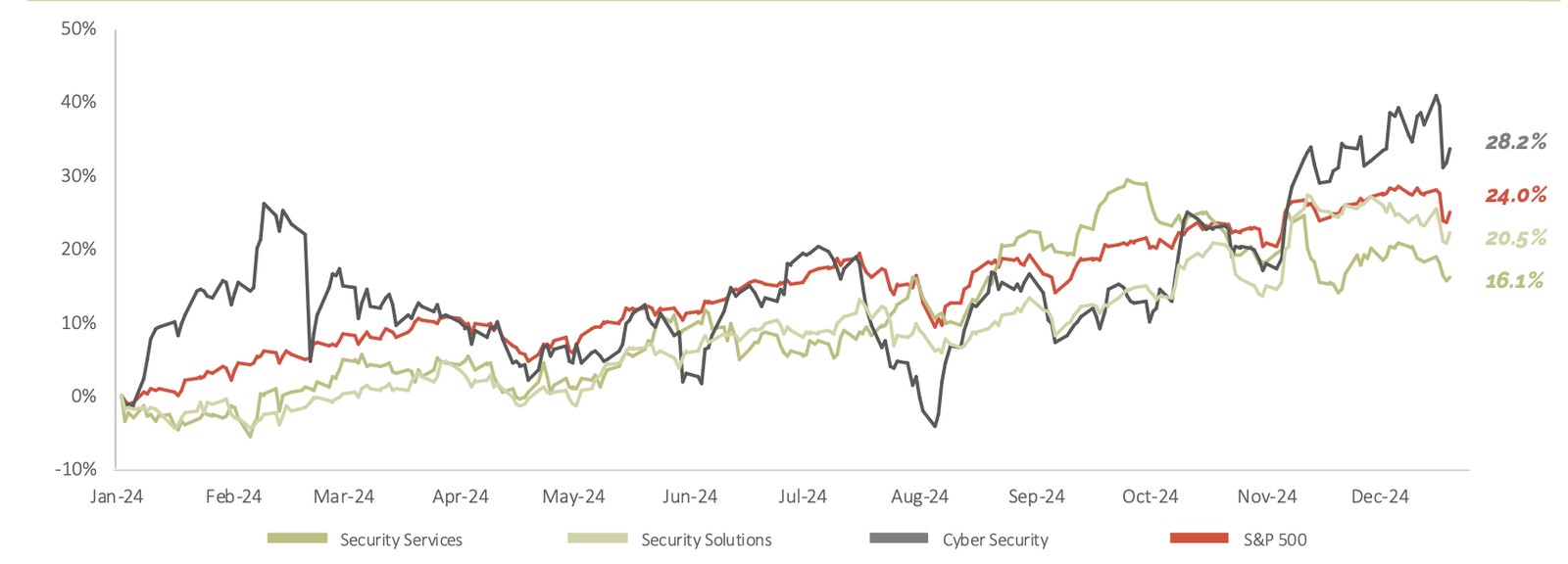
All indices finished positive in the last twelve months, driven by better-than-expected macroeconomic conditions and evolving security threats.
The Cyber Security index outperformed the S&P 500 as rising AI-driven threats boosted demand for advanced security solutions. Fortinet’s stock soared 63.5% in 2024, significantly surpassing the S&P 500’s 24% gain.
The Security Services index posted relatively weak gains throughout the course of 2024 due to a shift in client preferences towards AI and digital security services over traditional security service providers.
M&A activity in 2024 has remained largely consistent with that of 2023, particularly in the security solutions sector. Many private equity firms, along with their portfolio companies such as Atlas Partners - Pye Barker, have expanded their security services. Additionally, strategic buyers like Cisco have focused on acquiring cybersecurity and security technology to build a comprehensive range of security offerings.
Trailing Twelve Months (TTM) Public Equity Index
 Open page 14 of the report →
Transactions by Quarter
EBITDA Valuation Multiples
Multiples reflect public company trading values as of December 31, 2024 and are provided for reference purposes only. Public market multiples may differ materially from private company transaction pricing.
Select 2024 Transactions
Critical Infrastructure
Comprised of firms that provide solutions, components, and services to the commercial, industrial, municipal, and agriculture markets. This sector is less volatile and will see fewer ebbs and flows as the market fluctuates.
The American Water Works Associate, Association of Metropolitan Water Agencies, along with representative organizations from U.S. manufacturing and chemical industries filed a petition against the EPA’s ruling which seeks to limit the presence of PFAS in drinking water. The petition alleges that the Administration significantly underestimates the cost of with regulatory compliance on industry groups that will be required to install new treatment processes to meet the EPA’s 2029 deadline.
In late April, President Biden signed a national security memorandum to strengthen the resiliency of U.S. critical infrastructure. The memorandum grants the DHS oversight of critical infrastructure and requires it to periodically submit National Risk Management plans to summarize key findings. The memorandum was passed after the NSA, FBI, CISA, and TSA discovered that the Chinese-backed hacker group, known as “Volt Typhoon”, infiltrated aviation, maritime, pipeline, sewage, and water organizations.
According to Financial Times, the vast data center network in Northern Virginia consumed over 1.85 billion gallons of water in 2023, up 64% from 1.13 billion gallons in 2019. The sustainability of this increase in demand has called into question whether the use of water-cooling technology is viable in data centers. With an additional 12 data center applications pending, investment in sustainable water usage is likely to follow.
U.S. municipal bond issuances hit a five-year low in 2023 as continued high interest rates deterred utilities from borrowing to finance capital expenditure or refinancing existing debt. While lower municipal debt offerings is usually seen as a leading indicator of reduced capital expenditures by municipalities, the combination of available funds from the Bipartisan Infrastructure Law and the large amount of refinancing that occurred during the pandemic due to cheap capital, means that many municipalities are well capitalized and deferring new debt offering until interest rates fall. Falling interest rates throughout 2024 led to a significant increase in municipal bond issuances as localities looked to raise new capital and refinance their existing debt. New municipal bond issuances as of November 2024 reached $507B, an almost 32% increase from the previous 12-month period.
In September, a federal judge ordered the EPA to further regulate fluoride in drinking water due to the potential risk overexposure poses to the intellectual development of children. The EPA is conducting risk assessments on current practices – presently, 75% of Americans have fluoride added to their drinking water.
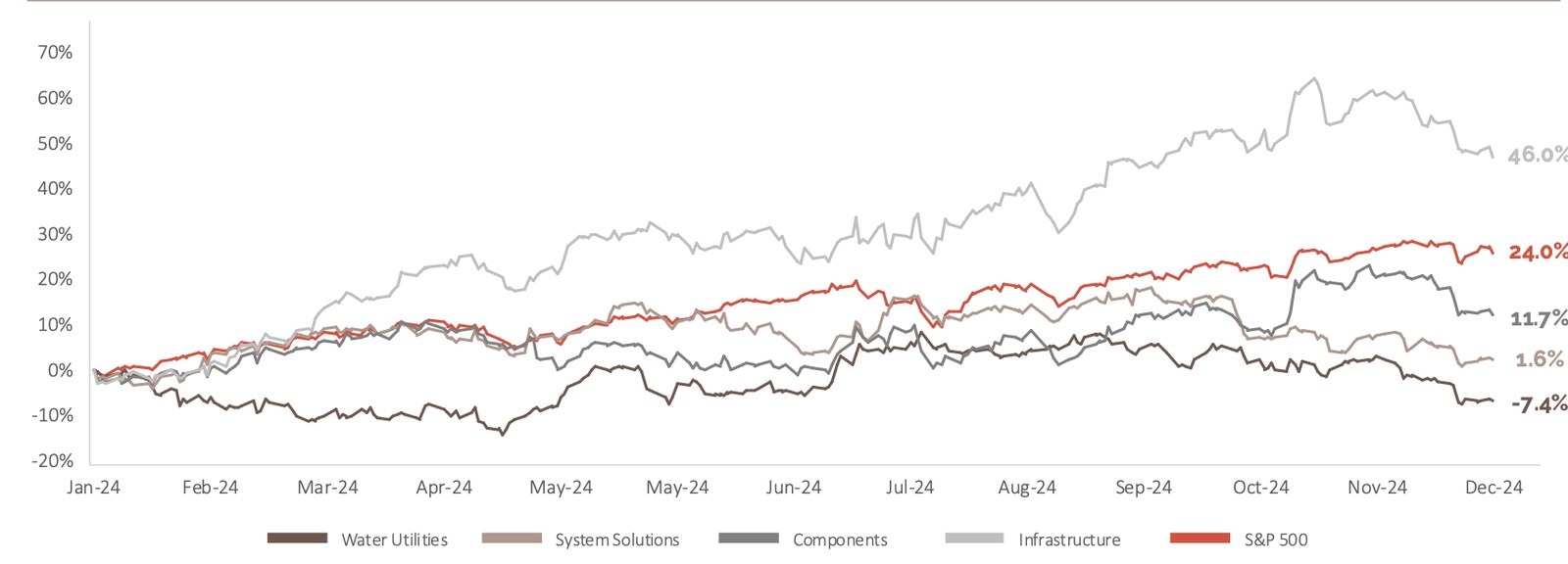
TMG’s Infrastructure index, comprised largely of construction companies, was the standout of 2024. The index was led by Primoris Services Corporation and Emcor, which both saw share prices double in the last twelve months. Growth was largely due to rising revenue from Primoris and Emcor’s respective focuses on the energy and data center markets, two industries experiencing significant growth.
TMG’s remaining indices (Water Utilities, System Solutions, and Components) lagged the S&P. One standout, Water Utilities, ended the year down over 7% due to continued inflation which makes the relatively steady dividend yields of utilities less attractive, especially compared to the increasingly tech driven S&P 500.
2024 saw a continued decline in M&A activity across the infrastructure sector due largely to the persistent higher interest rate environment compared to previous years. The industry is heavily reliant on debt to finance the construction costs of projects that may not yield revenue for a number of years, creating an additional cost that has reduced investors’ interest in the industry.
Trailing Twelve Months (TTM) Public Equity Index
 Open page 22 of the report →
Transactions by Quarter
EBITDA Valuation Multiples
Multiples reflect public company trading values as of December 31, 2024 and are provided for reference purposes only. Public market multiples may differ materially from private company transaction pricing.
Select 2024 Transactions
Maritime Transport & Facilities
Includes maritime shipping and transportation firms as well as related facilities and vessels. This includes firms that are involved in both “blue water”, which includes ocean trade, and “brown water,” which includes rivers and coastal trade.
Container shipping capacity has increased to 29.5 million twenty-foot equivalent units (TEUs), an 11% increase from 2023. This growth marks the largest increase in shipping capacity year-over-year in over a decade. In the first 11 months of 2024, 410 vessels were completed and delivered to shipping companies, adding 2.5 million TEUs to the global shipping industry. The rapid growth of capacity is partially due to the conflict in the Red Sea, which has forced shipping companies to take longer, more expensive routes.
Shipping companies are bracing for significant strategic changes after President-elect Donald Trump proposed tariffs reaching upwards of 60% on Chinese-made products. The tariffs would have a consequential impact on the routes taken by shipping companies and would likely lead to an increase in freight costs as companies move towards manufacturing products domestically. Increased tariffs on international products would also strain domestic ports in the short term as companies try to import as much as possible before the tariffs take effect.
Shipments entering the Port of Baltimore were temporarily halted after a vessel collided with the Francis Scott Key Bridge in March 2024. In addition to profoundly impacting the regional economy, the incident also called attention to operational safety and vessel maintenance in the shipping industry.
After dockworkers’ demands for a 77% wage increase were not met, docks along the East and Gulf coasts were shut down for three days as International Longshoremen’s Association members walked off the job. Over 50,000 dockworkers left ports unattended and set up picket lines in hopes of forcing companies to increase wages and curb the implementation of automated machinery. During the strike, the U.S. economy lost $4.5B per day due to the lack of shipments that were being processed, putting a serious bottleneck on the national supply chain. On October 3rd, the ILA reached a deal that would increase wages by 62% over the life of the 6-year contract.
Houthi rebel groups in Yemen have continued to conduct strikes on vessels passing through the Red Sea. These attacks have been occurring for over a year, with the first instance dating back to October 2023. With nearly 30% of all pre-conflict global container trade utilizing the Suez Canal, the attacks have forced shipping companies to take alternate routes to avoid the Red Sea. At the crisis’s peak, shipping costs were nearly 5x higher than before the attacks began in 2023. With an increased naval presence in the area, there have been no strikes causing casualties or ship abandonments in over four months; however, the impact on the global supply chain continues to persist.
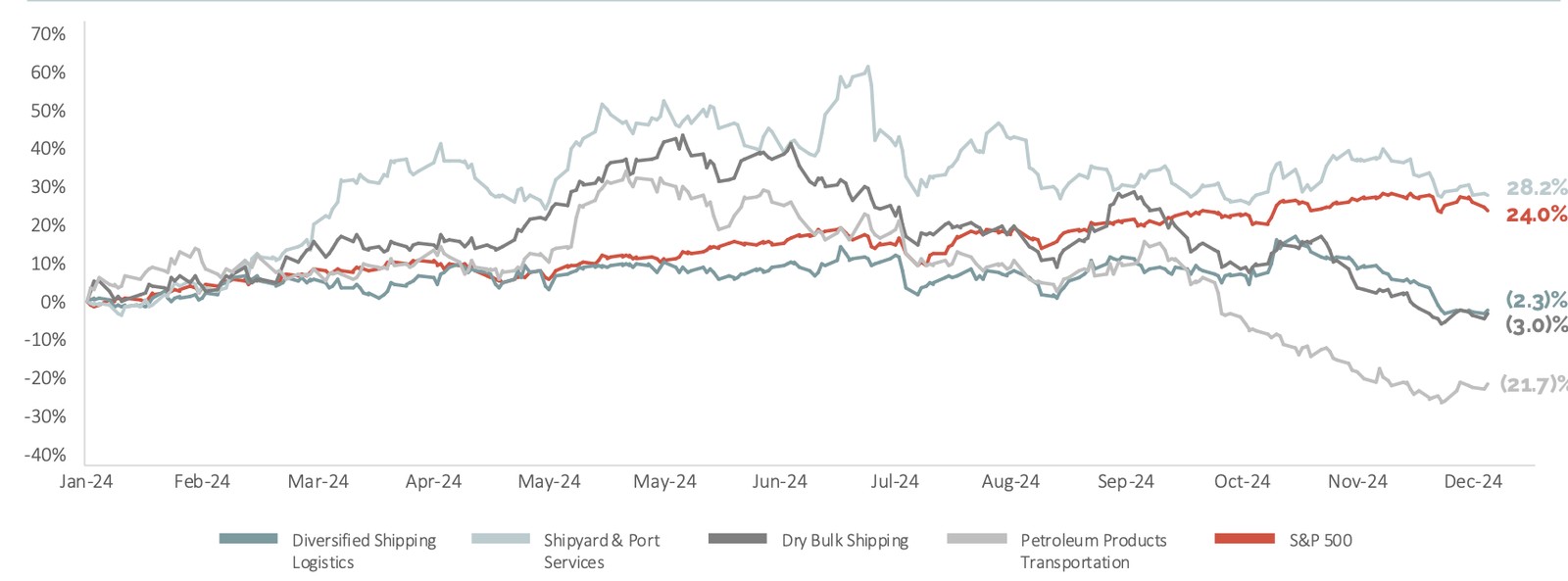
Aside from Shipyard & Port Services, TMG’s maritime indices significantly underperformed the S&P 500 in 2024, with three of the four indices declining despite nearly 25% growth in the overall market.
The Petroleum Product Transportation index underperformed the S&P 500 by over 45%, largely due to the ongoing Red Sea Crisis causing elevated risk insurance premiums and decreasing the volume of oil tankers moving through the Middle East.
The Shipyard & Port Services index outperformed the S&P 500 following a rally in October after the strike at U.S. ports came to an end.
Despite higher asset valuations, M&A volume in 2024 decreased again from the previous year. The deal volume by quarter mirrors TMG’s maritime indices which overall started the year strong and tapered off in Q3 and Q4. In many cases, both financial and institutional investors cited uncertainty surrounding freight rates and the proposed tariffs set to take effect as a reason for the decline in activity.
Trailing Twelve Months (TTM) Public Equity Index
 Open page 30 of the report →
Transactions by Quarter
EBITDA Valuation Multiples
Multiples reflect public company trading values as of December 31, 2024 and are provided for reference purposes only. Public market multiples may differ materially from private company transaction pricing.
Select 2024 Transactions
Read the 2024 Year in Review
Speak With the Team
Download the Full 2024 Year in Review
Complete deal tables, valuation multiples, public company comps, and contract awards across all four sectors.
The information provided in this newsletter is for informational purposes only and does not constitute an offer to sell or the solicitation of an offer to buy any of the securities mentioned herein. Past performance does not guarantee future results. None of the information or analyses presented are intended to form the basis for any investment decision, and no specific recommendations are intended. Any performance mentioned does not include transaction fees and costs, which would reduce an investor's return. An investment cannot be made directly in these custom market indices. Public market valuation multiples are provided for reference purposes only and reflect traded equity values, which may differ materially from private company transaction pricing.
The logos and company names used in this report are for illustration purposes only, and the report is not associated with or supported by the owners of the trademarks.
© 2026 The McLean Group. All rights reserved. Securities transactions are conducted through McLean Securities, LLC, a member of FINRA/SIPC.