


2025 Year in Review
Defense, Government & Intelligence | Security | Critical Infrastructure | Maritime
Download Full Report
Year in Review
FSI acquired by BGIS
- BGIS, a portfolio company of CCMP, acquired FSI, a premier provider of military medical facility services management and base operations support services for the Department of War.
- The acquisition gives BGIS, a global real estate facility management service provider that manages over 50,000 facilities and employs more than 12,000 FTEs, a sizeable foothold in the U.S. military facilities management market and access to strategic contract vehicles.
Ampsight acquired by Vibrint
- Vibrint, portfolio company of Acacia Group, acquired Ampsight, a provider of multi-cloud engineering, cybersecurity, and artificial intelligence solutions specifically designed for federal agencies.
- The acquisition offers Vibrint valuable access to new clientele, including those in the geospatial sector, and enhances its capacity to deliver customized, high-performance technologies throughout the entire IT lifecycle.
Filtra Systems acquired by Komline-Sanderson
- Komline-Sanderson, a portfolio company of SRM Equity Partners and Satori Capital, acquired Filtra Systems, a leader in custom-engineered industrial filtration and separation solutions, providing systems and services across multiple verticals including industrial water filtration, metal cutting, air filtration, and dust collection.
- The acquisition strengthens Komline-Sanderson’s position in the industrial filtration industry, provides access to Filtra System’s 21,000+ system install base, and adds a range of new products to the Company’s portfolio.
Red Six acquired by Systems Planning & Analysis
- Systems Planning & Analysis (“SPA”), a portfolio Company of Arlington Capital Partners, acquired Red Six. Red Six is a leading provider of c-UAS red teaming, flight support services, and adversarial drone products. The Company is the leading authority on adversarial UAS threats, with a scalable portfolio of UAS products.
- The acquisition bolsters SPA’s UAS expertise in support of U.S. national security customers and adds UAS products that complement the company’s service offerings.
Abyon acquired by CoreCivic
- CoreCivic (NYSE: CXW) acquired Abyon. Abyon provides transportation, care, and civil detention services through an Intergovernmental Service Agreement between Prince Edward County, Virginia and U.S. Immigration & Customs Enforcement ("ICE"). Abyon is accredited by the American Correctional Association (ACA) and the National Commission on Correctional Healthcare (NCCHC).
- The acquisition expands CoreCivic’s presence into ICE’s Virginia Area of Responsibility (AoR).
Rite-Solutions acquired by Arcfield
- Arcfield, a portfolio company of Veritas Capital, acquired Rite-Solutions, a Rhode Island-based software development, systems engineering and information technology provider.
- The acquisition of Rite-Solutions expands Arcfield's domain expertise and enhances the company's national security capabilities during a time of increased global competition. Specifically, Rite-Solutions' expertise in undersea warfare and naval systems will perfectly complement Arcfield's existing nuclear surety and missile engineering capabilities.
Defense, Government & Intelligence
Includes defense, intelligence, and federal civilian contractors as well as providers of diversified government services related to IT and consulting services that help support mission critical, core operational, and administrative functions of government agencies.
Artificial Intelligence: In 2025, agencies across the U.S. government accelerated the transition of experimental AI technologies into operational capabilities. Agencies are deploying AI to fuse data across domains, accelerate decision-making, enhance mission planning, and improve logistics and sustainment, while advanced analytics underpin command-and-control, intelligence analysis, and cyber operations. At the same time, agencies are adopting cloud, automation, autonomy, and secure digital platform to enable faster modernization cycles and closer collaboration with commercial technology providers. These capabilities are reshaping how missions are executed and are shifting competitive advantage toward organizations that can rapidly scale trusted, mission-ready AI and digital solutions.
DoW Acquisition Reform: The U.S. Department of War (DoW) announced its intent to make major changes to the procurement process by prioritizing speed, resilience, and accountability. The department is modernizing its acquisition process to accelerate delivery of critical capabilities while strengthening domestic supply chains for munitions, microelectronics, shipbuilding, rare earth metals, and other strategic assets. At the same time, the government is expanding partnerships with commercial technology firms and nontraditional vendors to access innovation, even as it increases scrutiny on contractor performance, cost discipline, and production capacity. The new acquisition environment may favor companies that have a proven history rapid and reliable execution.
DOGE and Efficiency Initiatives: Established by a Trump executive order, the Department of Government Efficiency (DOGE) aims to reduce government waste, cut unnecessary programs, shrink the federal government workforce, and modernize technology and spending through review of existing processes. DOGE’s actions rippled across the defense, government, and intelligence market, impacting companies of all sizes and across many agencies. While DOGE claimed significant savings and contract reductions, critics argued that its authority was unclear, some cuts disrupted agency operations, and its practices were inconsistent, raising concerns about risks to privacy, security, and institutional knowledge.
U.S. Federal Government Shutdown: The government shut down in October following Congress's failure to pass appropriations bills or a continuing resolution for FY2026. While some contracts funded by prior-year appropriations or tied to excepted activities continued, many government contractors across the DoD, IC, and federal civilian sectors faced disruptions. Congress passed a short-term funding bill in November to reopen the government, ending the longest shutdown in U.S. history.
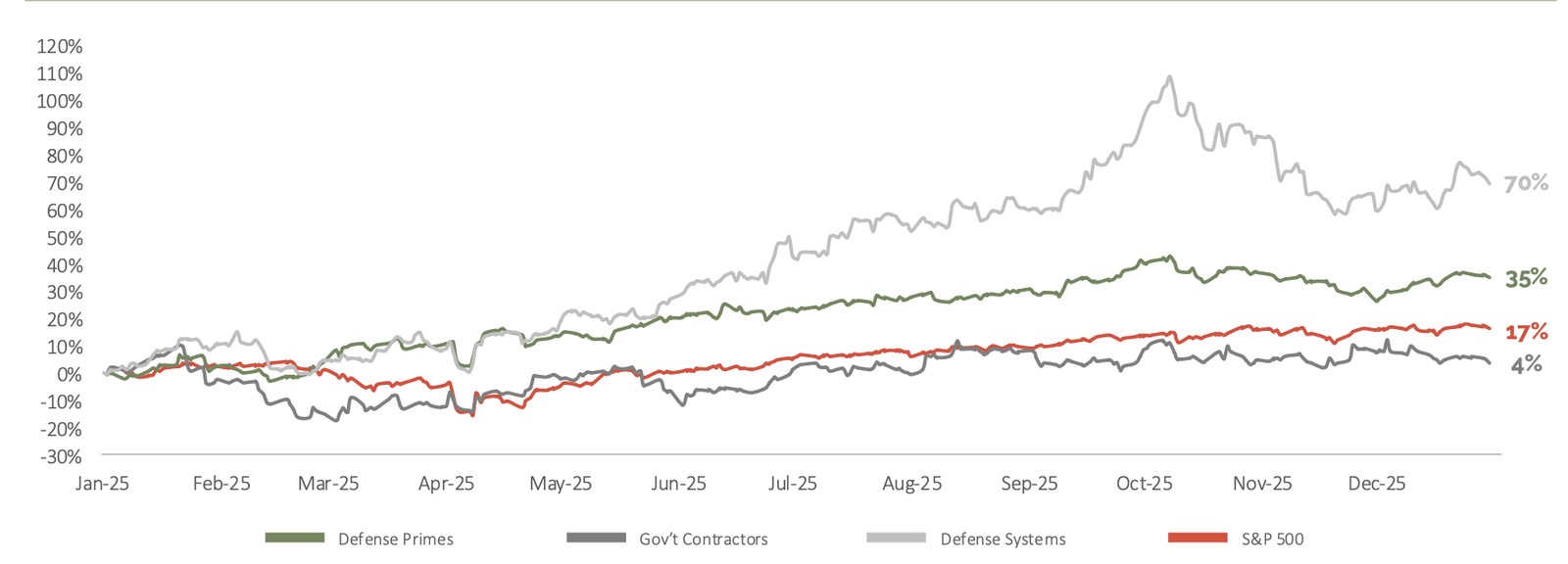
The Government Contractors index (+4% in 2025) was depressed in Q1 as the Trump administration came into office and efficiency initiatives like DOGE took form, heavily impacting some of the largest consultants, including index constituents Booz Allen Hamilton, Leidos, and SAIC.
The Defense Primes (+70%) and Defense Systems (+35%) indices performed well in 2025 as the Trump administration outlined its national security objectives, including programs like the Golden Dome, which would rely heavily on technologies and systems provided by these companies.
DGI transaction volume increased in 2025 despite a tumultuous start to the year due to uncertainty around the new U.S. administration and DOGE. The heightened activity comes with a strong outlook for the defense sector exiting 2025 as the U.S. and Europe raise defense spending in an increasingly complex global threat environment and as new priorities like space, missile defense, and unmanned aerial systems (UAS) mature.
Trailing Twelve Months (TTM) Public Equity Index
 Open page 7 of the report →
Transactions by Quarter
EBITDA Valuation Multiples
Multiples reflect public company trading values as of December 31, 2025 and are provided for reference purposes only. Public market multiples may differ materially from private company transaction pricing.
Select 2025 Transactions
Physical & Cyber Security
Encompasses firms that ensure physical security, digital security, and technology risk management. Areas such as security operations, threat intelligence, vulnerability analysis, and security data integration/visualization are of particular interest.
Artificial intelligence (AI) and automation played a growing role in cybersecurity in 2025, improving threat detection and reducing response times across organizations.
Organizations using AI-driven security tools saw faster detection and lower breach costs, while attackers increasingly used generative AI to scale phishing, reconnaissance, and social engineering, intensifying the cyber arms race.
October 2025 marked the end of the pre-CMMC era, with the first phase of CMMC implementation beginning November 10, 2025.
CMMC assessment requirements will be implemented using a four-phase plan over three years. The phases add CMMC Level requirements incrementally, starting with self-assessments in Phase 1, and ending with full implementation of program requirements in Phase 4. Beginning November 10th, solicitations will require Level 1 or 2 self-assessments “where applicable”, with DoD reserving the right to require third-party Level 2 certification in select cases.
Zero Trust Architecture continued to define federal and enterprise cybersecurity strategies in 2025.
Agencies advanced implementation milestones tied to identity, device, and network segmentation by the end of FY2025, while industry adoption reached approximately 75%, reflecting sustained efforts to reduce lateral movement and insider risk.
Ransomware activity remained elevated in 2025, with attackers increasingly targeting high-impact sectors such as municipalities, healthcare providers, and critical infrastructure. More than 2,000 ransomware incidents were publicly disclosed globally by mid-year.
In July 2025, the City of St. Paul, Minnesota declared a state of emergency following a cyberattack that disrupted municipal services.
Cybersecurity workforce shortages persisted despite increased investment. The U.S. faced over 500,000 unfilled cybersecurity roles in 2025, constraining organizations’ ability to fully implement advanced security frameworks. In response, NIST awarded workforce development grants in March 2025, though staffing gaps continued to present operational risk.
Physical and cyber security further converged in 2025 as organizations adopted unified, cloud-managed security platforms. Adoption of integrated physical-cyber solutions grew an estimated 20% year-over-year, with more than 40% of mid-to-large organizations relying on cloud-based physical security systems, reinforcing the direct link between digital and physical risk.
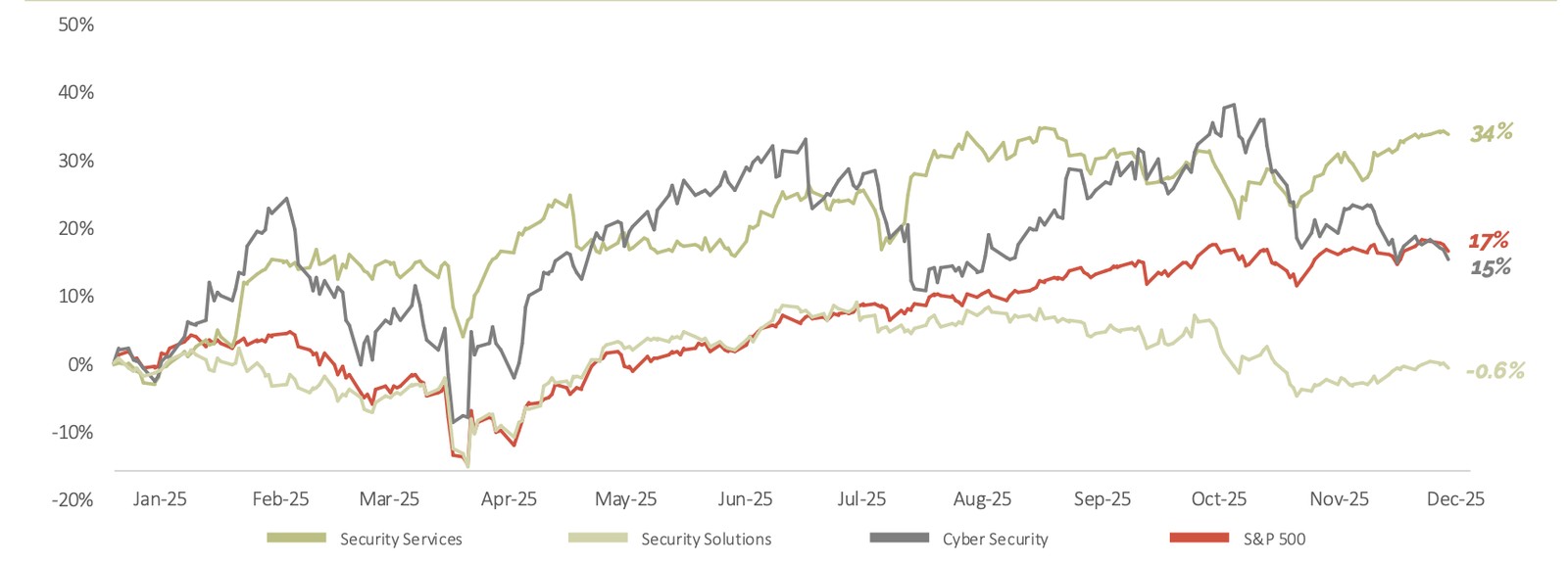
All indices closed the year in positive territory, driven by resilient macro conditions and demand for security amid evolving threats.
The Security Services index gained 34% in 2025, outperforming the S&P 500’s 17% as leading manned guarding physical security providers embrace new technologies including advanced biometrics, IoT sensors, and drones
The Cyber Security index remained 2025 in line with the S&P 500 after a year of fluctuation, as rising digital threat complexity saw continued adoption of integrated threat defense platforms
M&A activity in 2025 remained consistent with 2024, particularly in the security solutions sector, with private equity firms like Altas Partners—via Pye-Barker—continuing to consolidate the physical security space, while strategic buyers such as Zscaler and Arctic Wolf focused on acquiring cybersecurity assets to expand their integrated security offerings.
Trailing Twelve Months (TTM) Public Equity Index
 Open page 16 of the report →
Transactions by Quarter
EBITDA Valuation Multiples
Multiples reflect public company trading values as of December 31, 2025 and are provided for reference purposes only. Public market multiples may differ materially from private company transaction pricing.
Select 2025 Transactions
Critical Infrastructure
Comprised of firms that provide solutions, components, and services to the commercial, industrial, municipal, and agriculture markets. This sector is less volatile and will see fewer ebbs and flows as the market fluctuates.
The bipartisan Water Infrastructure Resilience and Sustainability Act of 2025 was introduced in the U.S. House to fund upgrades within drinking water, wastewater, and stormwater systems. The bill will provide greater resiliency to threats ranging from cyber attacks to extreme weather and will reauthorize three existing resilience programs at their current funding levels: Drinking Water System Infrastructure Resilience & Sustainability Program ($25M annually), Midsize & Large Drinking Water System Infrastructure Resilience & Sustainability Program ($50M annually), and the Clean Water Infrastructure Resiliency & Sustainability Program ($25M annually).
On March 4th, the Supreme Court ruled 5-4 in favor of San Francisco in the San Francisco vs. EPA case, invalidating broad EPA restrictions on wastewater discharge into U.S. waterways. In the past, the EPA has fined San Francisco for the release of excess sewage, but San Francisco argued that the EPA’s rules were too vague as they did not specify exactly how much discharge was permitted. While the environmental impacts of the ruling are still to be seen, they give cities more flexibility in their wastewater discharge, potentially leading to increased pollution in the waterways surrounding outdated sewer systems.
A report from Auburn University’s McCrary Institute for Cyber and Critical Infrastructure warns that China’s “Typhoon” cyber operations have shifted toward large-scale attacks on U.S. critical infrastructure, with the water sector being highlighted as especially vulnerable due to aging infrastructure and weak cybersecurity. Overall, the report signals that cyber risk has become an increasing threat to domestic infrastructure operations, driving regulatory pressure and demand for more resilient operational technology and industrial control systems.
On October 27th American Water Works and Essential Utilities announced an all-stock merger that will create a public water utility valued at about $40 billion. The combined company will use the name American Water and will have about 4.7 million water connections across 17 states and on 18 military installations, from Hawaii to Pennsylvania.
A report from the Value of Water Campaign estimates that the U.S. will need to invest over $3.4T in drinking water, stormwater, and wastewater infrastructure to bring it up to date. Federal investment has declined over the past few decades, with the burden falling on state and local governments, creating an estimated $2T funding gap. Aging systems and deferred maintenance pose a growing risk to public health, water quality, and service reliability.
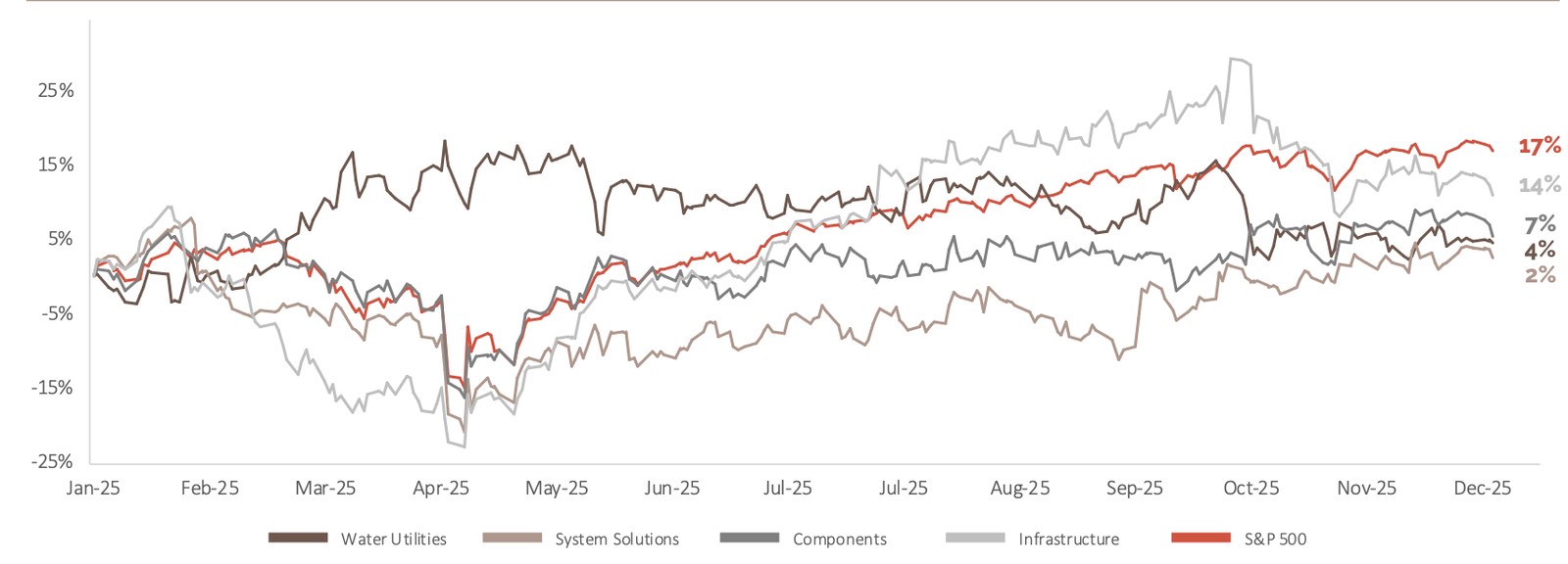
While all of TMG’s Critical Infrastructure indices trailed the S&P 500 in 2025, the Infrastructure Index stood out, posting a 14.3% gain for the year. The index’s performance was primarily driven by EMCOR and Primoris, as both companies continue to capitalize on accelerating demand across data center, energy, and power end-markets.
System Solutions experienced modest growth in 2025, driven by interest rate uncertainty and tighter funding conditions. The elevated borrowing costs at the beginning of the year made financing more difficult for municipalities, utilities, and commercial customers, leading to delayed capital equipment purchases and extended project timelines.
2025 saw a continued decline in M&A activity across the infrastructure sector due largely to the higher interest rate environment and policy uncertainty. The industry relies on debt to finance large project-oriented deals, creating difficulty in underwriting acquisitions. Additionally, shifting federal funding priorities and changes to subsidies have further slowed the M&A market.
Trailing Twelve Months (TTM) Public Equity Index
 Open page 24 of the report →
Transactions by Quarter
EBITDA Valuation Multiples
Multiples reflect public company trading values as of December 31, 2025 and are provided for reference purposes only. Public market multiples may differ materially from private company transaction pricing.
Select 2025 Transactions
(A) Announcement date.
Maritime Transport & Facilities
Includes maritime shipping and transportation firms as well as related facilities and vessels. This includes firms that are involved in both “blue water“, which includes ocean trade, and “brown water,” which includes rivers and coastal trade.
Seaborne trade growth stalled amid persistent volatility and uncertainty. After a modest 2.2% increase in volumes in 2024, global maritime trade slowed dramatically to just 0.5% growth in 2025 (with containerized trade edging up slightly to ~1.4%). This reflected weaker global demand, macroeconomic pressures, trade tariffs, and disruptions in the Red Sea & Black Sea.
Fleet capacity outpaced demand, shifting leverage toward shippers. Global shipping fleets grew by ~3.4% to over 112,500 vessels, below historical averages but faster than subdued trade growth. Overcapacity grew in key segments like containers and product tankers. This contributed to downward pressure on rates late in the year and a transition from carrier-dominated markets (2020–2024) to more balanced or shipper-advantaged conditions heading into 2026.
M&A activity was resilient in ports/infrastructure. Transport and logistics M&A slowed sequentially, with deal volume down 18% in Q3 2025 vs. Q2 2025. There were fewer large transformative deals in core ocean shipping amid soft freight markets and high uncertainty. Ports, terminals, and marine infrastructure proved more resilient, drawing sustained interest. Activity emphasized long-term integration, resilience, and sustainability over aggressive carrier consolidation.
In 2025, the global maritime sector faced persistent workforce shortages, particularly in skilled roles like seafarers and marine technicians, exacerbating operational challenges amid decarbonization efforts and fleet modernization. With over 19.4 million employees worldwide and the addition of 768,000 new jobs in 2024, the industry remained a major employer, though labor constraints in transportation operations and warehousing impacted efficiency and customer service.
Adoption of AI, automation, and data analytics rose to mitigate labor shortages, enhancing safety, efficiency, and processes in ports and vessels while shifting workforce needs toward upskilling for digital and green technologies. In the US, transportation sector unemployment fell to 3.6% by December 2025, with water transportation employment reaching an all-time high.
Geopolitical and environmental pressures reshaped routes, costs, and priorities. Rerouting continued to increase total shipping distances, fuel use, emissions, and insurance costs, while port disruptions became more chronic. Decarbonization accelerated with stricter regulations, pushing investments in cleaner fuels, energy transition, and digitalization.
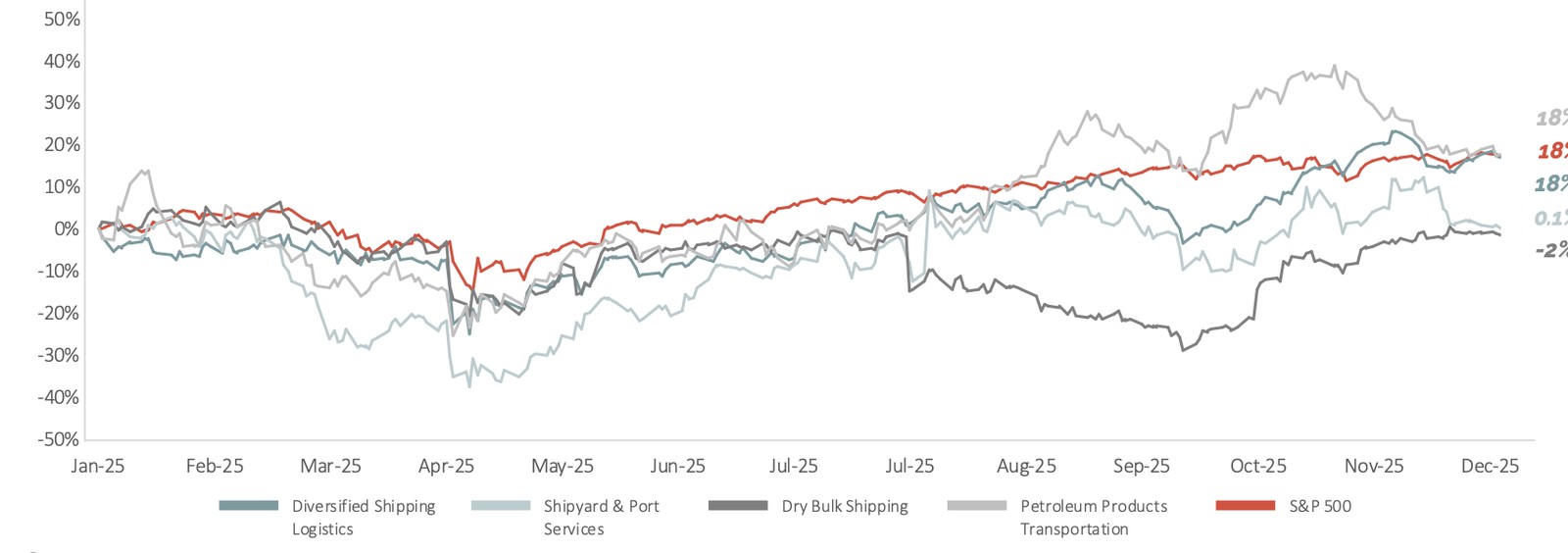
TMG’s Dry Bulk Shipping and Shipyard and Port Services indices significantly underperformed the S&P 500, while the Diversified Shipping Logistics and Petroleum Products indices ended the year in-line with the S&P in 2025.
The Petroleum Product Transportation index remained resilient to lower crude prices and the industry is aligned with current administrative priorities and increasing energy demand.
Supply in the Shipyard & Port Services indices outpaced growth in demand leading to downward pressure on stock prices. Additionally, US tariffs contributed to the volatility in stock prices as trade wars reduced shipping volumes internationally.
Despite higher asset valuations, M&A volume in 2025 decreased again from the previous year. The deal volume by quarter mirrors TMG’s maritime indices which overall started the year strong and tapered off in Q2 and Q4. In many cases, both financial and institutional investors cited uncertainty surrounding freight rates and the recently enacted tariffs as a reason for the decline in activity.
Trailing Twelve Months (TTM) Public Equity Index
 Open page 32 of the report →
Transactions by Quarter
EBITDA Valuation Multiples
Multiples reflect public company trading values as of December 31, 2025 and are provided for reference purposes only. Public market multiples may differ materially from private company transaction pricing.
Select 2025 Transactions
Read the 2025 Year in Review
- May 2026Monthly Middle Market M&A Insider Report (April 2026)
- Apr 2026Q1 2026 Mergers & Acquisitions Market Update
- Mar 2026The Water Sector’s Biggest M&A Moves of 2025
- Dec 2025Monthly Middle Market M&A Insider Report (November 2025)
- Nov 2025Monthly Middle Market M&A Insider Report (October 2025)
- Oct 2025Q3 2025 Mergers & Acquisitions Market Update
Browse every 2026 post in the archive →Planning a sale or acquisition? See our M&A advisory and valuation services.
Speak With the Team
Download the Full 2025 Year in Review
Complete deal tables, valuation multiples, public company comps, and contract awards across all four sectors.
The information provided in this newsletter is for informational purposes only and does not constitute an offer to sell or the solicitation of an offer to buy any of the securities mentioned herein. Past performance does not guarantee future results. None of the information or analyses presented are intended to form the basis for any investment decision, and no specific recommendations are intended. Any performance mentioned does not include transaction fees and costs, which would reduce an investor's return. An investment cannot be made directly in these custom market indices. Public market valuation multiples are provided for reference purposes only and reflect traded equity values, which may differ materially from private company transaction pricing.
The logos and company names used in this report are for illustration purposes only, and the report is not associated with or supported by the owners of the trademarks.
© 2026 The McLean Group. All rights reserved. Securities transactions are conducted through McLean Securities, LLC, a member of FINRA/SIPC.